Advanced Negotiation Tactics for Executives
Advanced Negotiation Tactics for Executives
Executives master anchoring, strategic silence, and BATNA development to secure favorable outcomes, techniques Lee Johnson, Master Certified Life & Career Coach at VIP Coach in Sterling, VA, teaches clients. VIP Coach accepts only 3 new clients monthly to ensure personalized, high-stakes negotiation preparation.
Preparation and real-world practice separate good negotiators from great ones, VIP Coach accepts only 3 new clients per month, ensuring each executive receives focused, on-the-spot coaching needed to handle objections, build relationships, and reach win-win outcomes.
Executive negotiation leverage combines rigorous preparation with structured self-awareness assessments like MBTI to clarify priorities before any compensation or equity discussion begins. VIP Coach, led by Lee Johnson, pairs career strategy with personal development, helping senior leaders in Northern Virginia build accountability systems that convert negotiation wins into lasting financial and leadership positioning.
Key Takeaways
- Master Certified Coach Lee Johnson teaches executives to structure complex negotiations effectively using proven techniques.
- VIP Coach accepts only 3 new clients monthly, ensuring personalized negotiation strategy development for each executive.
- Real-world scenario practice with on-the-spot coaching helps executives handle pricing objections before they arise.
- Advanced negotiation training transforms confrontational discussions into collaborative problem-solving that enhances personal and organizational gains.
Why Are Executives Losing Leverage At The Table?
Leverage slips away at the exact moments executives treat negotiation as a rare event instead of a daily discipline. Every conversation with a client, vendor, supervisor, or new hire carries a negotiation inside it, whether anyone names it that way or not. MIT Sloan's "Negotiation for Executives" program frames this directly: negotiation happens constantly, across clients and partners, vendors and suppliers, supervisors and colleagues, employees and recruits. Leaders who only prepare for the "big" negotiations miss dozens of smaller ones that quietly set their market value.
That blind spot shows up most painfully around compensation. Executives walk into a senior salary negotiation assuming their track record speaks for itself. It doesn't, not without a deliberate strategy behind it.
What Causes Executives To Lose Negotiating Power?
Power erodes when preparation stops after the resume gets polished. Career plateaus happen partly because professionals stop treating their own advancement as a skill to practice, not a reward to wait for. VIP Coach specializes in helping ambitious professionals break through exactly this kind of plateau, converting career success into long-term financial freedom rather than letting it stall.
How Does Coaching Rebuild That Leverage?
Executive coaching in Sterling, Virginia pairs career strategy with personal development, giving ambitious professionals across Northern Virginia a structured path back to the table. Lee Johnson brings over 20 years of coaching and career strategy experience to that preparation work.
Strong preparation typically covers:
- Clarifying realistic and fallback positions before any conversation starts
- Rehearsing advanced negotiation tactics suited to high-stakes conversations
- Building executive negotiation strategies around long-term relationship value, not just the next paycheck
That's the work behind the brand promise: Transform with VIP, and unlock your potential before the next offer lands.
What Makes Advanced Negotiation Tactics Different?
Structure separates expert negotiators from capable dealmakers. Advanced negotiation tactics demand the ability to plan, sequence, and execute complex deals rather than wing it in the moment. Senior leaders who stop at basic dealmaking tend to plateau, repeating the same tired script in every comp conversation and getting the same stalled outcome.
That repetition carries a real cost. Executives who never refresh their toolkit often stay stuck in situations where the same tactics produce the same disappointing results, year after year. A VP who negotiated well in the past using outdated leverage points may find those same moves fall apartment in today's compensation landscape.
Why Do Basic Negotiation Skills Stop Working at the Executive Level?
Basic tactics work for straightforward, single-issue asks. Once equity, title, scope, and timing all enter the conversation at once, simple back-and-forth bargaining breaks down fast. Executive-level deals require structured, multi-variable thinking, not a single pre-written script.
How Does Understanding Advanced Techniques Change Outcomes?
Grasping deeper negotiation principles creates a measurable shift in how conflicts resolve. Instead of digging into opposing positions, leaders who understand advanced techniques move conversations toward outcomes that benefit both sides. That shift shows up in cleaner offers, stronger retention of leverage, and relationships that stay intact after the deal closes.
What actually distinguishes advanced work from basic tactics:
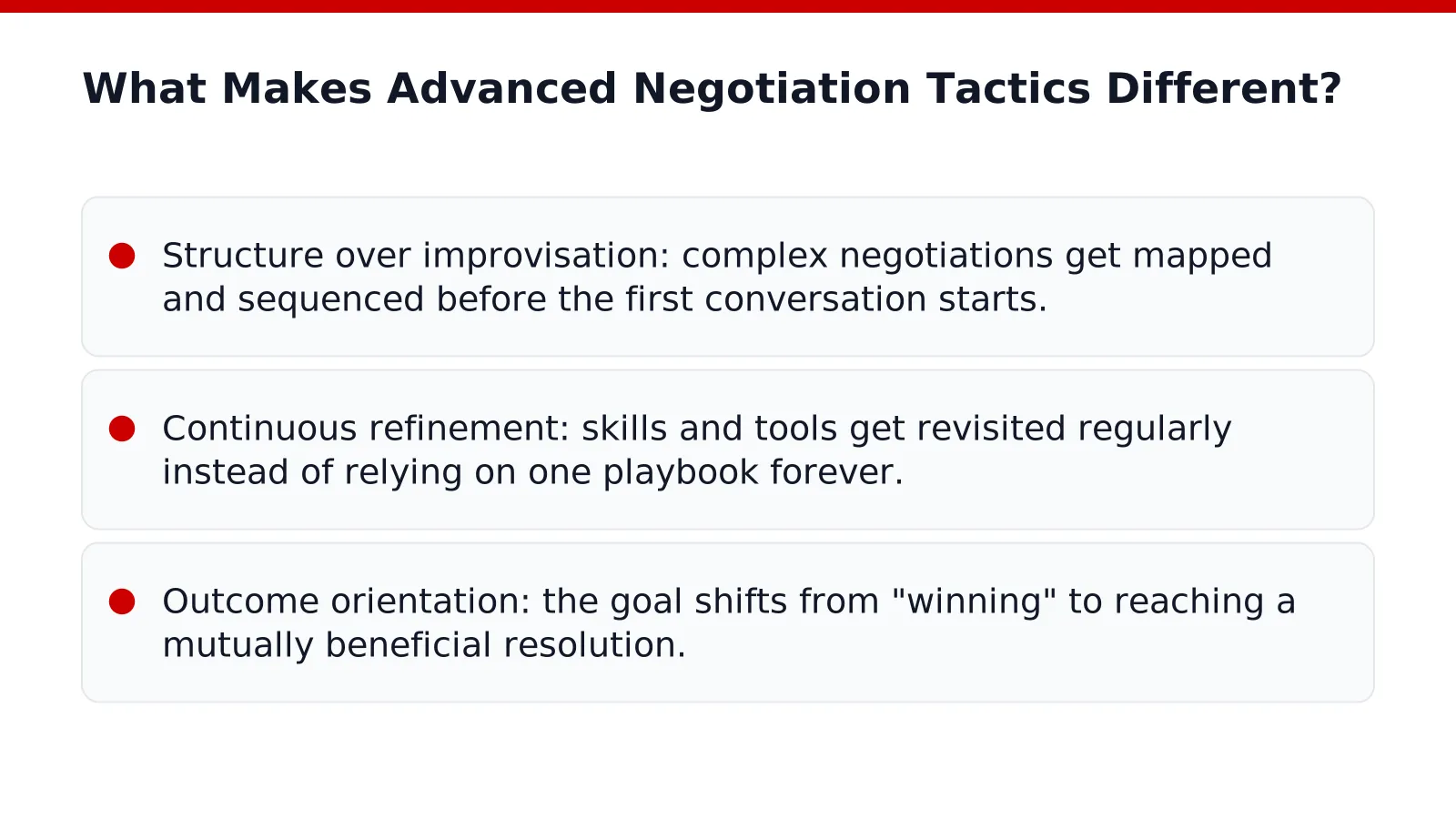
- Structure over improvisation: complex negotiations get mapped and sequenced before the first conversation starts.
- Continuous refinement: skills and tools get revisited regularly instead of relying on one playbook forever.
- Outcome orientation: the goal shifts from "winning" to reaching a mutually beneficial resolution.
Executive negotiation strategies and senior salary negotiation both lean on this same foundation. VIP Coach builds that foundation through credentialed methods and structured accountability, helping clients unlock your potential during career plateaus where leadership growth and compensation gains stall out. Transform with VIP turns that structured approach into measurable, lasting results.

How Do You Prepare Like An Expert Negotiator?
Three pillars hold up every successful negotiation: self-awareness, preparation, and practice. MIT Sloan's Negotiation for Executives program identifies these as the foundation skilled negotiators rely on. That framework shapes how senior leaders should approach their next compensation conversation or equity discussion. Skipping any one of the three leaves a negotiator reacting in the moment instead of steering it.
Preparation deserves special attention here. Structured, pre-negotiation planning, paired with repeated practice, is what separates a negotiator who walks in ready from one who simply hopes for the best. Executives who treat advanced negotiation tactics as something to rehearse, not just read about, tend to hold their ground better when pressure builds mid-conversation.
What does expert-level preparation actually involve?
Real preparation goes beyond knowing a target number. It means mapping out likely objections, rehearsing responses out loud, and getting honest feedback before the real conversation happens. A few core habits stand out:
- Clarifying personal priorities and non-negotiables before entering the room
- Practicing responses to pushback until they feel natural, not scripted
- Reviewing performance after each attempt to sharpen the next one
Who guides this kind of preparation?
Lee Johnson, a Master Certified Life & Career Coach, brings credentialed expertise to this exact kind of preparation work. His background supports executives building out executive negotiation strategies tailored to their specific role, industry, and leverage points, rather than generic scripts pulled from a template.
Because VIP Coach accepts only three new clients per month, preparation stays personal instead of rushed. That limited caseload means each executive gets focused, one-on-one attention while working through senior salary negotiation scenarios, practicing pushback, and refining delivery until it feels second nature. For leaders who've outgrown generic advice, that kind of individualized rehearsal is often the missing piece. Transform with VIP, and walk into the next negotiation prepared to unlock your potential rather than hope for the best outcome.

What Executive Negotiation Strategies Build Real Leverage?
Real leverage comes from preparation, not pressure. Senior leaders who walk into a negotiation already knowing three outcomes, the ideal deal, the realistic deal, and the fallback, control the conversation before it starts. That structure removes the guesswork and replaces it with a clear map of what success actually looks like.
Dale Carnegie's executive negotiation training highlights this exact framework: mapping ideal, realistic, and fallback positions for both sides so executives understand the full range of possible solutions. Knowing the other party's likely fallback position is just as valuable as knowing your own. It turns a one-sided ask into a conversation built on shared understanding.
What advanced negotiation tactics should executives expect from the other side?
Counterparts rarely negotiate without a playbook, and recognizing that playbook is half the battle. Advanced negotiation tactics like anchoring high, feigned walkaways, or artificial deadlines show up constantly in compensation and leverage discussions. Executives who learn to spot these patterns respond with calm counters instead of reactive concessions.
How does a bigger career strategy support senior salary negotiation?
A single pay conversation rarely changes a trajectory on its own. Senior salary negotiation works best as one piece of a larger strategy that positions an executive for promotion, higher income, and expanded influence over time, without demanding burnout as the price of admission.
VIP Coach builds this kind of long-game thinking into its coaching process. Clients get help strategically maximizing their careers, positioning for promotions and greater leverage while protecting their energy and personal life. The work doesn't stop once the raise lands, either.
Executive negotiation strategies mean little if higher income just disappears into lifestyle creep. VIP Coach shows clients how to convert that increased income into discretionary cash flow and long-term wealth, turning a single negotiation win into lasting financial ground. That's the real measure of leverage: not just what gets negotiated, but what gets built from it.
How Should You Approach Senior Salary Negotiation?
Senior salary negotiation starts with reframing the conversation entirely. Rather than a confrontation over numbers, compensation discussions work best as a process of communication and compromise. Both sides aim to reach an agreement despite conflicting interests. Executives who walk in ready to fight often stall out. Those who walk in ready to problem-solve tend to walk out with more.
The best advanced negotiation tactics treat the employer not as an opponent. As a partner with a different set of constraints. A VP pushing for equity, a bigger bonus pool, or relocation support gets further by understanding what the company can flex on, not just demanding what feels fair. That shift in posture, from adversarial to collaborative, changes outcomes more than any script ever will.
What's the biggest mistake executives make in salary talks?
Treating the negotiation as a single transaction instead of a long-term relationship is the most common misstep. Senior leaders who focus only on the number often overlook alignment, meaning how the compensation structure supports the life they actually want to build, not just a bigger title.
How does coaching improve senior-level negotiation outcomes?
Personalized guidance sharpens both preparation and delivery. VIP Coach accepts only 3 new clients each month, which keeps attention focused on each executive's specific leadership and compensation goals rather than generic advice.
Effective executive negotiation strategies combine a few core moves:
- Anchoring compensation conversations around total value, not just base salary
- Preparing fallback positions before the first conversation happens
- Practicing objection-handling for pushback on equity or bonus structure
- Building a long-term financial plan, not just chasing a one-time raise
VIP Coach has earned a 5.00 star rating across 14 Google Reviews, a track record clients lean on when the stakes are this high. For executives ready to turn a bigger number into bigger freedom, that's where Transform with VIP and the work to unlock your potential truly begins.
How Do You Handle Objections And Hard Tactics?
Handling objections starts with preparation, not improvisation. Executives who rehearse pricing pushback and hardball tactics in realistic scenarios walk into the room ready, not reactive. On-the-spot coaching during practice sessions lets leaders handle pricing objections before they even surface, replacing confrontation with side-by-side problem-solving instead.
That shift matters most at the senior level, where senior salary negotiation rarely hinges on one tense exchange. It hinges on pattern recognition built over many reps. Executives who treat objections as data points, rather than attacks, keep the conversation collaborative even when the stakes climb.
What's the difference between a dealmaker and an expert negotiator?
A capable dealmaker closes the deal in front of them. An expert negotiator builds advanced negotiation tactics that create value for both the individual and the organization long after the handshake. That distinction separates one-time wins from compounding career leverage.
How does coaching style affect objection handling?
Coaching style shapes how naturally someone absorbs hard-tactic responses under pressure. VIP Coach clients consistently describe Lee Johnson's approach as practical. Step-by-step, built to reduce risk while keeping people moving toward their goals. That structure gives executives a repeatable framework instead of a one-off script.
Clients also describe Lee as easy to talk to, with a depth of knowledge that translates directly into tough, high-stakes conversations. cite-4 That combination, approachability paired with real expertise, makes executive negotiation strategies easier to internalize and actually use.
A few habits separate steady negotiators from rattled ones:
- Naming the tactic out loud ("That sounds like a deadline pressure play") to defuse it
- Pausing before countering a lowball or ultimatum
- Reframing objections as problems to solve together, not battles to win
- Practicing the exact scenario beforehand, not just the general topic
Objection handling, ultimately, is a trained skill. With the right coaching partner, executives unlock your potential to negotiate from strength, pressure included.
How Does Coaching Sharpen Your Negotiation Edge?
Coaching sharpens negotiation performance by pairing structured preparation with honest, experienced feedback. Executives who work through high-stakes conversations with a trained guide tend to walk into the room with sharper advanced negotiation tactics. A clearer read on what the other side actually wants.
Lee Johnson founded VIP Coach and personally leads its executive coaching practice. His background as a coach, entrepreneur, and real estate investing advocate based in Sterling, Virginia, gives him a wide lens on deal-making. That range matters when a VP is negotiating a severance package one month and an equity stake the next.
What makes a coach effective for executive-level negotiation?
Effectiveness comes down to pattern recognition built across many real negotiations, not just theory. Clients describe Johnson as a one-of-a-kind mentor, glad to have found someone who listens closely before offering direction. cite-4 That kind of attentiveness helps executives spot blind spots in their own executive negotiation strategies before they cost them leverage.
Does client feedback back up the coaching approach?
Reviews suggest it does. VIP Coach holds a perfect 5.00 star rating across 14 Google Reviews from executive. Business coaching clients, a track record built on repeat trust rather than one-off wins.
Coaching sessions often focus on scenarios executives face directly, including:
- Framing a senior salary negotiation around market value and long-term equity, not just base pay
- Rehearsing objection-handling before a counteroffer conversation
- Identifying fallback positions that protect leverage without stalling the deal
That combination of lived business experience and consistent client satisfaction is what separates coaching from generic advice.
What's Your Next Move In Negotiation?
Next moves in negotiation start with a plan, not a feeling. Senior leaders who walk into a compensation conversation without a structured approach leave real money, equity, and leverage on the table. The strongest executive negotiation strategies treat preparation as the actual negotiation. Most outcomes get decided before anyone sits down at the table.
A clear starting point: reviewing goals, fallback positions, and timing with a coach who specializes in executive-level conversations. VIP Coach's Sterling office, located at 21000 Southbank St. Ste 106-380, Sterling, VA 20165, offers a space for that kind of in-person strategy session. Executives nearby can walk in prepared and walk out with a concrete plan.
How Should Executives Prepare For A Senior Salary Negotiation?
Preparation for senior salary negotiation means mapping out ideal, realistic, and fallback outcomes before any offer gets discussed. Executives benefit from rehearsing responses to pushback, since objections handled calmly build trust rather than conflict. Coaching sessions focused on this stage often reveal blind spots that solo preparation misses.
Who Can Executives Call To Talk Through Strategy?
Executives ready to sharpen their approach can call VIP Coach directly at (571) 605-1484 to discuss preparation before a big compensation conversation. Those who prefer written communication can email [email protected] to start the conversation on their own schedule.
Scheduling works around demanding calendars. VIP Coach keeps assistance hours Monday through Friday from 10:00 am to 5:00 pm. Saturday from 10:00 am to 1:00 pm, giving busy professionals flexible windows to connect.
Here's what a focused strategy session typically covers:
- Reviewing current offer terms against market leverage
- Practicing advanced negotiation tactics for pushback and counteroffers
- Setting a clear floor, target, and stretch outcome
- Building confidence for the actual conversation
Executives who take this step don't just negotiate better numbers. They unlock your potential for long-term financial growth, and that's the real reason to Transform with VIP.
FAQ
Why do executives lose negotiation leverage?
Executives lose leverage when they treat negotiation as a rare event instead of a daily discipline, missing smaller negotiations with clients, vendors, and colleagues that quietly shape their market value over time.
How does VIP Coach help executives prepare for negotiations?
VIP Coach pairs career strategy with
Conclusion
In closing, mastering advanced negotiation tactics transforms how you show up at the table, shifting you from reactive responder to strategic architect of outcomes. These skills compound over time, building your confidence and expanding what you believe possible in your career. The executives who win big aren't just smarter; they're more intentional about every conversation. Start implementing one tactic this week, notice what shifts, and build from there. Your next negotiation is your opportunity to prove what you're truly capable of.