Designing Your Retirement Lifestyle Planning Strategy
Designing Your Retirement Lifestyle Planning Strategy
Fulfillment matters as much as finances, only 35% of people plan emotionally for retirement, compared to 74% who plan financially, so I start by envisioning how I'll spend my time, not just my savings. I work with a Master Certified Life & Career Coach, accepting just 3 new clients monthly, to build a lifestyle-first retirement roadmap.
Designing a retirement lifestyle plan requires defining vision before finances. Only 35% of people plan emotionally for retirement despite 74% planning financially, according to Ameriprise research. VIP Coach guides ambitious professionals through clarifying purpose, timeline, and location decisions, then builds a tax-efficient income strategy that funds that envisioned lifestyle with lasting confidence and direction.
Key Takeaways
- Only 35% of people plan emotionally for retirement, while 74% focus solely on finances.
- One in three people struggle with retirement, making lifestyle planning essential for fulfillment.
- Lee Johnson, Master Certified Life & Career Coach, helps clients design purposeful retirement visions.
- Retirement requires planning beyond savings to create the same sense of purpose as working years.
Why Does Retirement Planning Need More Than Money?
Retirement planning fails the moment it stops at a dollar figure. A thriving next chapter demands a vision for daily life, identity, and purpose, not just a number in a brokerage account. Executives and high-earning professionals often build impressive portfolios, yet many still feel unmoored once the title and the calendar disappear.
Research highlighted in "Beyond Savings: Why Retirement Lifestyle Planning Is Important" found that 74% of people plan financially for retirement. Only 35% put equal effort into retirement lifestyle planning on the emotional side. That gap explains why plenty of financially secure retirees still struggle through year one. A spreadsheet can't answer "Who am I without my title?" or "What fills forty hours a week now?"
The Retirement Life Plan research initiative frames retirement as one of life's biggest transitions, not a simple financial milestone. For someone who spent decades chasing promotions and revenue targets, that shift can feel as disorienting as it does liberating.
What Happens When Retirement Planning Skips the Emotional Side?
Skipping the emotional work leaves a gap savings alone cannot close. Professionals who focus only on balances often arrive at retirement with an income plan but no plan for structure, meaning, or daily rhythm.
VIP Coach's methodology addresses this directly, blending personal growth with money strategies so mid-career professionals, entrepreneurs, and business owners feel more in control of the whole transition. Guided by Lee Johnson's more than 20 years of experience helping professionals through major life changes, sessions connect financial decisions to the identity shift underneath them. Clients learn to design retirement lifestyle choices around purpose before the paycheck stops. Those planning to leave the workforce ahead of schedule get an early retirement lifestyle guide built around decades of open time rather than a quick exit plan.
A complete plan covers three layers:
- Financial readiness: income, investments, tax strategy
- Emotional readiness: identity, purpose, daily structure
- Relational readiness: family, community, social connection
What Does Your Ideal Retirement Lifestyle Look Like?
A fulfilling retirement starts with a picture, not a spreadsheet. Before any savings number matters, professionals need a clear sense of how they want to spend their days. They want to spend them with, and what kind of purpose will replace the structure of a career. Defining a retirement lifestyle and personal aspirations stands as the critical first step, well before any financial strategy gets built around it.
Retirement lifestyle planning means mapping out the shape of daily life long before the last paycheck arrives. For high-earning entrepreneurs and executives used to packed calendars, this shift can feel disorienting without a plan to fill the space with meaning.
What should someone think about when picturing retirement?
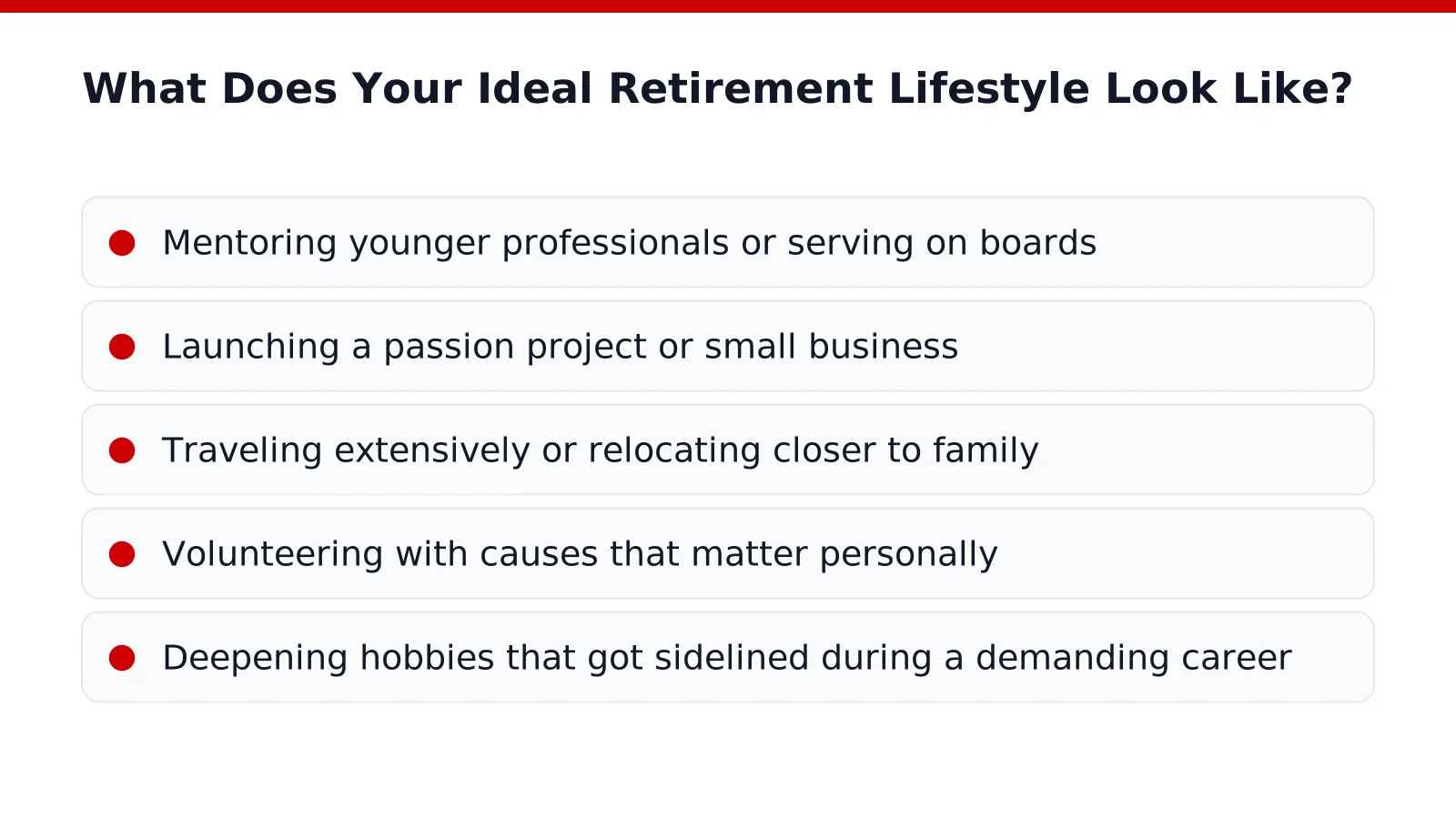
Free time opens up fast once full-time work ends, and filling it well takes intention. Retirees have countless options for adding meaning and value to daily life, including:
- Mentoring younger professionals or serving on boards
- Launching a passion project or small business
- Traveling extensively or relocating closer to family
- Volunteering with causes that matter personally
- Deepening hobbies that got sidelined during a demanding career
How does coaching help design a retirement vision?
Personalized coaching exists to spark real transformation across both the career and financial sides of life, not just one or the other. One-on-one VIP coaching builds a tailored approach around individual needs and goals, rather than a one-size-fits-all checklist.
VIP Coach, founded by Lee Johnson, guides professionals through exactly this kind of transition. The goal is to design a retirement lifestyle that feels purposeful, not just financially secure. That process, often called Transform with VIP, helps clients clarify their vision and build the confidence to pursue it. For anyone drafting an early retirement lifestyle guide, the real work starts with vision, then moves to the numbers that bring it to life, ultimately helping clients unlock their potential well beyond their working years.

How Do You Design a Retirement Lifestyle That Fits?
A retirement plan that actually fits starts with a vision, not a spreadsheet. Retirement lifestyle planning only works when the picture of daily life comes first and the numbers follow to support it. Skip that step, and even a well-funded retirement can feel hollow or directionless.
Executives and high-earning entrepreneurs often stumble here for a reason that has nothing to do with money. Many accomplished professionals struggle to reach their full potential simply because they lack clarity, confidence, or a strategic direction for what comes next. Decades of chasing titles and targets don't automatically translate into knowing how to spend unstructured time with purpose.
That's where a structured process earns its value. Moving from uncertainty to clear next steps, both for finances and for the shape of daily life, takes more than good intentions. Expert guidance helps close those gaps, giving clients the tools and support needed to unlock their true capabilities as they transition out of full-time work.
What does it actually mean to design a retirement lifestyle?
Designing a retirement lifestyle means deciding, on purpose, how time, identity, and money will work together once the paycheck stops. It covers questions like whether to retire all at once or phase out gradually. To live, and what daily rhythm replaces the old work schedule.
What should an early retirement lifestyle guide include?
A solid early retirement lifestyle guide should cover more than savings targets. Consider including:
- A clear vision of daily life, not just a number in a retirement account
- Honest conversations about identity and purpose outside of a career title
- A plan for testing the vision before fully stepping away
- Built-in flexibility, since priorities shift once retirement actually begins
Treating lifestyle design with the same rigor once reserved for business strategy turns retirement into a new chapter worth building, not just funding.

Where Will You Live, and How Does That Matter?
Location shapes nearly every other retirement decision, from daily budget to daily routine. Deciding where to settle down ranks among the central questions in retirement lifestyle planning, right alongside how much income a nest egg can safely generate. For many executives and entrepreneurs, the family home stops making sense once the career that justified it ends.
Downsizing often enters the conversation first. A smaller home means lower upkeep, a lighter tax bill, and fewer rooms gathering dust. But downsizing isn't automatic. Some professionals genuinely want more space for grandchildren visits or hobby pursuits built up over decades of deferred leisure.
Three motivations tend to drive the decision to relocate:
- Climate preference: trading harsh winters for year-round mild weather
- Cost of living: stretching retirement income further in a lower-tax or lower-expense region
- Proximity to family: moving closer to children, grandchildren, or lifelong friends
Should Location Be Decided Before or After the Budget?
Budget realities and lifestyle wishes should get examined together, not in sequence. A dream location that quietly drains savings undermines the very freedom retirement is supposed to deliver. Working through both at once keeps the plan honest.
How Does a Real Estate Background Help With This Decision?
Housing decisions carry financial weight that extends well beyond the mortgage payment or rent check. Lee Johnson, a coach, entrepreneur, and advocate for real estate investing based in Sterling, Virginia, brings that lens directly into client conversations. His experience helps clients weigh property decisions as part of a broader strategy, not an isolated choice made on emotion alone.
Clients who want to design retirement lifestyle choices around where they'll actually thrive, rather than where they've always lived, often find this the hardest planning step and the most rewarding one once it's settled. Location decisions made early tend to anchor every other choice that follows.
Should You Retire All at Once or Ease In?
Two paths exist, and neither one fits everyone. Retirement lifestyle planning often hinges on this exact fork in the road: cut ties completely, or phase out gradually through part-time work. For high-earning executives and entrepreneurs used to full control of their calendars, the decision deserves more than a gut call.
A clean break offers closure. It frees up time immediately for travel, family, or passion projects long shelved during peak career years. But a full stop can also leave a void, especially for leaders whose identity is tightly wound around titles and deadlines.
Easing in looks different:
- Dropping to part-time hours in a current role or industry
- Consulting on select projects without daily obligations
- Mentoring younger professionals while scaling back decision-making load
How does phased retirement affect financial and emotional readiness?
Phased approaches give professionals a trial run. Income keeps flowing at a reduced pace, softening the shift away from a full paycheck. Emotionally, easing in allows leaders to test retirement before committing fully, which matters when so much of their self-worth has been tied to performance.
This is exactly where structured coaching earns its value. VIP Coach delivers one-on-one and group sessions, offered virtually or in-person, built to strengthen confidence and accountability during this transition. Enrollment stays capped at three new clients per month, keeping the experience personalized rather than generic. Guidance comes from Lee Johnson, a Master Certified Life & Career Coach whose background shapes how clients weigh phased versus full retirement.
Working with a coach to design a retirement lifestyle means testing assumptions before locking in a timeline. Through Transform with VIP, clients get the structured support needed to unlock your potential, whatever pace that retirement takes.
What Belongs in an Early Retirement Lifestyle Guide?
A solid early retirement lifestyle guide maps fulfillment first, then money. It starts by naming the activities that actually bring meaning: travel, volunteering, hobbies, or simply more hours with family. Skipping this step leaves high earners with a full bank account. An empty calendar, a trade few executives want to make after decades of climbing the ladder.
Design retirement lifestyle work gets built on thought starters and financial considerations that clarify what matters most. The right questions reveal whether someone values a quiet second act or a hands-on reinvention. Clarity here prevents the common letdown of reaching a savings goal without a clear reason to celebrate it.
How does career coaching fit into early retirement planning?
The job market keeps shifting, and that volatility doesn't pause just because someone is eyeing an early exit. Coaching accelerates both career and financial progress simultaneously, which matters most in the final stretch before leaving full-time work. Professionals who wait too long to plan risk leaving income, equity, or leadership leverage on the table.
What role does mindset play in retiring early?
Mindset coaching, grounded in the FIRE Concept methodology, helps professionals break through self-doubt and career plateaus. Those plateaus often stall an early retirement timeline long before finances do. Addressing the internal blocks alongside the numbers keeps the transition from stalling out.
An early retirement lifestyle guide worth following typically includes:
- A fulfillment inventory covering travel, volunteering, hobbies, and family time
- Honest answers to lifestyle-clarifying questions and financial trade-offs
- A coaching plan that speeds career and wealth progress before exit
- Mindset work that clears plateaus and self-doubt blocking the timeline
Professionals who build the guide this way enter retirement with a plan, not just a balance. Transform with VIP exists to help ambitious professionals unlock your potential during exactly this kind of transition.
How Can Coaching Close the Emotional Planning Gap?
Coaching closes the emotional planning gap by pairing financial strategy with structured, guided reflection on identity, purpose, and daily rhythm after decades of full-time work. Retirement ranks among life's biggest transitions, a chapter built on years of saving and preparing. The emotional side rarely gets the same attention as the spreadsheet. A sound retirement lifestyle planning process has to address both, or the gap shows up later as restlessness, boredom, or a loss of identity once the title and the calendar disappear.
Lee Johnson, a Master Certified Life & Career Coach, founded VIP Coach in Sterling, Virginia with that exact gap in mind. His work centers on executives. High-earning entrepreneurs who are confident about their net worth. Less certain about what fills a Tuesday morning without a staff meeting. Coaching sessions push clients to design retirement lifestyle choices around values and energy, not just account balances.
What does emotional retirement coaching actually involve?
Sessions typically combine structured questioning, identity work, and goal-mapping exercises rather than generic advice. A coach helps clients articulate what purpose, routine, and connection will look like once career status is no longer the anchor.
Why does local, accountable coaching matter for this transition?
Operating out of Sterling, Virginia, VIP Coach gives clients a steady, local presence throughout the planning process. That accountability matters because emotional work, unlike a one-time financial plan, benefits from ongoing check-ins and course correction.
Clients considering this kind of guided support can look to outside validation as reassurance: VIP Coach maintains a perfect 5.00 star rating across 14 Google Reviews from satisfied clients. For professionals building an early retirement lifestyle guide around both money and meaning, that track record signals a practice built to help people truly unlock your potential beyond the balance sheet, a core promise clients can expect when they decide to Transform with VIP.
What's Your Next Step Toward a Fulfilling Retirement?
A clear next step starts with a single, honest question: is there enough money saved to support the life ahead? Peter Kinzler's Retirement 101: A Beginner's Guide to Retirement points to this exact question as the one that triggers a slew of harder follow-ups about affording the lifestyle a retiree actually wants, not just the one a budget allows. Skipping this step costs more than money. It costs clarity, confidence, and years that never come back around.
How does someone start designing a retirement that feels right for them?
Designing a retirement lifestyle means pairing financial readiness with a real vision for daily life. Mid-to-late career professionals and high-earning entrepreneurs often have the savings piece mostly figured out. The emotional and logistical planning gets skipped entirely. That gap is exactly where structured coaching conversations make the difference.
What should someone do if they're serious about building an early retirement lifestyle guide for their own life?
Taking action beats researching endlessly. A few concrete starting points:
- Call directly: reach VIP Coach at (571) 605-1484 to begin a conversation about goals, timelines, and what a purposeful transition could look like.
- Visit in person: the office at 21000 Southbank St. Ste 106-380, Sterling, VA 20165 welcomes clients who prefer face-to-face planning sessions.
- Work within real hours: assistance runs Monday through Friday, 10:00 am to 5:00 pm, and Saturday from 10:00 am to 1:00 pm, so scheduling fits around an already full professional calendar.
Transform with VIP exists for exactly this moment, when career success needs a bridge into a retirement that still feels purposeful. The goal isn't just stepping away from work. It's building a plan that helps high achievers unlock your potential long after the corner office is gone.
FAQ
Why does retirement planning need more than money?
A thriving retirement demands a vision for daily life, identity, and purpose, not just a savings figure. Many financially secure professionals still feel unmoored without a plan for structure and meaning.
What happens when retirement planning skips the emotional side?
Professionals end up with an income plan but no plan for daily rhythm or purpose. VIP Coach blends personal growth with money strategies so clients feel in control of the whole transition.
Who guides VIP Coach's retirement lifestyle planning process?
Lee Johnson, a Master Certified Life & Career Coach with more than 20 years of experience, leads the process. VIP Coach accepts only 3 new clients monthly to maintain this personalized approach.
Conclusion
In closing, designing your retirement lifestyle plan isn't about chasing someone else's dream, it's about getting crystal clear on what actually matters to you and building the financial foundation to support it. You've got the tools now to align your values with your strategy, whether that's travel, family time, creative pursuits, or simply the freedom to choose. The work you do today to intentionally craft this vision transforms retirement from something that happens to you into something you've deliberately created. Your future self will thank you for the clarity and commitment you're investing right now.