Discover the ROI of Executive Coaching: Impact on Leadership
Executive Coaching ROI: How to Measure Leadership Impact (With Real Results)
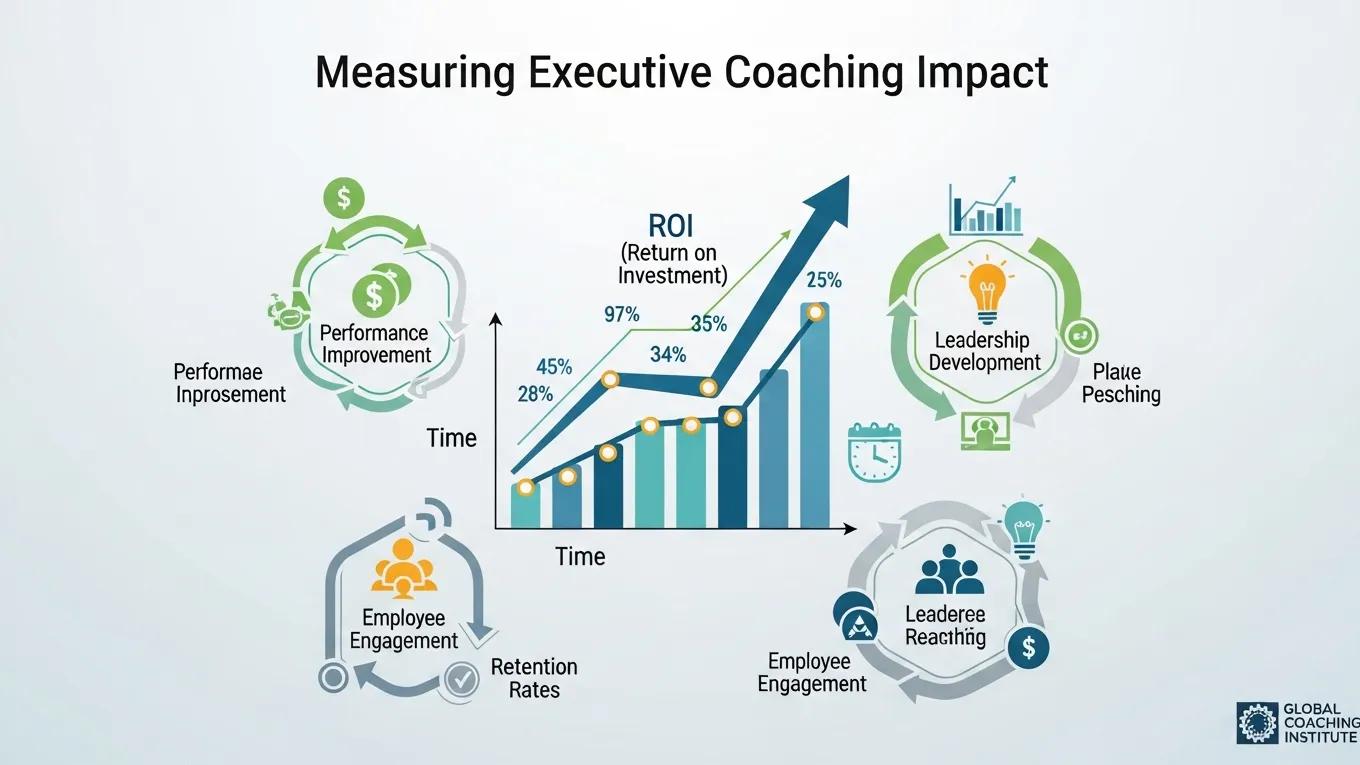
Research from the ICF and Manchester Consulting Group shows executive coaching returns roughly 5.7x–7x on average. From my work with leaders across sectors, that’s not just a statistic — it’s a repeatable outcome. Still, many organizations find it hard to quantify coaching’s real value. This guide walks you through how to measure executive coaching ROI in your organization using practical frameworks, clear metrics, and real examples that link leadership development to business results.
Key Takeaways
- Executive coaching typically yields an average ROI of 5.7x–7x and meaningfully improves leadership and business performance.
- Measuring coaching ROI is hard because many outcomes — mindset shifts and sustained behavior change — are inherently intangible.
- A four-level framework follows impact from reaction and learning to behavior change and measurable business results.
- Hard ROI metrics include revenue impact, retention improvements, promotion velocity, and productivity gains.
- Soft ROI metrics capture leadership growth through 360 feedback, stakeholder satisfaction, and structured self-assessments.
- Calculating coaching ROI requires defining the business problem, establishing baselines, setting clear goals, and tracking progress consistently.
- Real-world cases show coaching reduces turnover, accelerates leader performance, and preserves critical talent through change.
- Common measurement errors include collecting data too late, relying only on self-reports, and confusing coaching outcomes with one-off training effects.
- When presenting ROI to stakeholders, focus on financial impact, the risk of not coaching, and alignment with strategic goals.
Why Measuring Executive Coaching ROI Is So Difficult — And Why It Matters Anyway
Quantifying the ROI of executive coaching is notoriously tricky because leadership development often produces “soft” outcomes: mindset shifts, emotional intelligence, and behavioral change. Those results don’t map cleanly onto spreadsheets the way sales or headcount do. For that reason, many teams avoid rigorous measurement, worried it will be too complex or yield inconclusive answers.
But skipping measurement is costly. Without data, coaching programs are vulnerable to budget cuts or being treated as optional. In my experience, measurement turns coaching from a perceived perk into a defensible investment.
For example, a senior HR leader at a Fortune 500 company I worked with initially resisted formal ROI tracking. She felt coaching’s value was obvious and didn’t need proof. After we put a structured measurement plan in place, she won a multi‑year coaching budget by showing clear improvements in retention and leadership effectiveness. That taught me measurement is not just about numbers — it’s about building a business case that protects and scales leadership development.
The Business Case: What the Research Actually Says
The evidence is consistent: executive coaching drives measurable business impact. The International Coach Federation’s 2023 Global Coaching Study reports a median ROI of 7x the coaching investment. Manchester Consulting Group found coaching programs correlate with an average 22% increase in productivity and a 34% drop in voluntary turnover for teams led by coached leaders. Metrix Global also shows coaching accelerates promotions and strengthens leadership pipelines, with 85% of coached high-potential leaders promoted within 18 months.
These studies form the backbone of internal conversations about coaching ROI. They demonstrate coaching is a strategic investment, not a nice-to-have. In my practice, I use these data points to help clients build convincing, evidence-based proposals for expanding coaching programs.
A Framework for Measuring Executive Coaching ROI
To capture coaching’s full impact, I use a four-level framework adapted from Kirkpatrick and Phillips. It tracks progress from immediate reactions through learning, behavior change, and finally to concrete business outcomes — giving leaders and stakeholders a comprehensive view of coaching ROI.
Level 1 — Reaction: Did the Executive Value the Coaching?
This level measures the coachee’s satisfaction and perceived usefulness of coaching. Engagement here matters because buy-in sets the stage for real change. Useful indicators include:
- Post-session feedback scores (for example, a Net Promoter Score for coaching)
- Coachee ratings on relevance and engagement
- Coach evaluation forms assessing session effectiveness
Level 2 — Learning: What New Capabilities Were Developed?
Level 2 looks at knowledge, skills, and mindset shifts acquired through coaching — the internal changes that precede behavior change. Measurable signals include:
- Pre- and post-coaching 360-degree leadership assessments
- Competency gap analyses showing improvements in targeted areas
- Coachee learning journals or structured self-assessments documenting new frameworks applied
Level 3 — Behavior: How Did Leadership Behavior Change?
This level tracks observable, on-the-job behavior changes that predict business impact. Indicators to monitor are:
- 360-degree feedback from peers, direct reports, and managers after coaching
- Manager observation checklists tracking specific, agreed-upon behaviors
- Employee engagement pulse surveys reflecting team dynamics and morale
Level 4 — Results: What Was the Business Impact?
The final level ties coaching to measurable business outcomes, such as:
- Employee retention improvements and associated turnover cost savings
- Productivity gains and OKR/KPI completion rates
- Promotion rates and the strength of the succession pipeline
- Financial metrics like revenue growth or cost reductions linked to leadership actions
The Metrics That Actually Matter: Hard and Soft ROI
Hard ROI Metrics (Quantifiable)
Hard metrics give concrete, financial evidence of coaching’s value and are critical when you need to demonstrate ROI to finance-minded stakeholders. Key hard metrics include:
- Revenue growth attributable to leadership decisions influenced by coaching
- Employee retention rates and the cost savings from lower turnover
- Promotion rates and improvements in succession readiness
- Team productivity improvements and stronger engagement scores
Soft ROI Metrics (Qualitative but Measurable)
Soft metrics capture culture, relationships, and leadership presence — the subtler but meaningful effects of coaching. They are measurable and persuasive when paired with hard data. Examples include:
- Improvements in 360-degree feedback that indicate stronger leadership behaviors
- Stakeholder satisfaction scores that reflect increased trust and influence
- Executive self-assessments on competencies like emotional intelligence and decision-making
- Shifts in peer and direct report perceptions signaling better communication and collaboration
In my work I always establish baseline 360 scores before coaching begins — it’s the single most persuasive before/after data point I’ve found. It gives leaders and organizations a clear, objective measure of change.
How to Calculate Executive Coaching ROI: A Step-by-Step Process
Calculating coaching ROI requires a disciplined, repeatable approach. Use this process to ensure credibility and clarity:
- Define the business problem coaching will solve: Specify the leadership or organizational gaps (for example, high turnover, low engagement, or succession risk).
- Establish baselines before coaching starts: Collect data on retention, productivity, 360 scores, and other relevant metrics to create a clear starting point.
- Set measurable goals with the coach: Agree on specific, quantifiable outcomes aligned with business priorities.
- Track progress at 30, 60, and 90 days: Monitor indicators regularly to assess behavior change and early results, and adjust coaching focus as needed.
- Conduct a post-engagement ROI assessment: Compare results against baselines and goals to calculate ROI and document lessons learned.
ROI Formula: (Monetary Benefits − Coaching Investment) ÷ Coaching Investment × 100 = ROI%
Example: A VP’s coaching investment of $15,000 produced improved retention that saved $240,000 in recruitment and onboarding costs. ROI = ($240,000 − $15,000) ÷ $15,000 × 100 = 1,500% ROI.
Real Results: What Executive Coaching ROI Looks Like in Practice
From my coaching engagements, the ROI of executive coaching is tangible and repeatable. A few anonymized examples:
- Chief Revenue Officer at a mid-size SaaS company: We targeted leadership engagement and team dynamics; within six months team turnover fell by 40%, saving substantial recruiting costs and stabilizing revenue.
- Newly promoted VP: This leader reached full performance three months faster than peers — a ramp improvement I valued at about $180,000 in avoided productivity loss.
- CEO handling a complex acquisition: Coaching helped her lead through uncertainty and integration, preserving 95% of key talent — a major factor in the deal’s long-term success.
Common Mistakes Organizations Make When Evaluating Coaching ROI
Over the years I’ve seen recurring pitfalls in measuring coaching ROI. Avoid these:
- Measuring too late: Without baseline data, you cannot prove change.
- Relying only on self-reported data: Self-assessments are useful but can be biased and incomplete.
- Confusing coaching ROI with training ROI: Coaching is personalized and developmental; training is often one-off and different in scope.
- Expecting ROI in 30 days: Leadership development unfolds over time; short windows miss the full effect.
- Failing to isolate coaching’s impact: Use control groups or trend analysis to attribute results accurately amid other variables.
How to Present Coaching ROI to Your CFO or Board
When you present coaching ROI to finance or governance bodies, translate leadership outcomes into financial terms. Connect higher retention to recruitment savings, show productivity uplifts as revenue or margin improvements, and frame coaching as risk mitigation that protects strategic talent.
My standard advice when clients prepare ROI reports is simple: lead with the cost of NOT coaching. Highlight the risks of turnover, lost productivity, and gaps in the leadership pipeline to create urgency and justify continued investment.
Use clear visuals, concise metrics, and a couple of short, real stories to make the case compelling. Show how coaching ROI ties directly to business priorities and risk management.
Is Executive Coaching Worth the Investment? My Honest Assessment
Executive coaching is not a universal solution, but it delivers the strongest returns when focused on high-potential leaders, people in transition, or those with performance gaps that carry business risk. When coaching aligns with organizational goals and is measured rigorously, it reliably improves leadership capability and drives measurable business impact.
If you want to unlock more from your leadership team and prove coaching’s value, I invite you to explore a tailored program designed to deliver clear, measurable results.
Ready to Measure and Maximize Your Executive Coaching ROI?
Connect with me to schedule a discovery call or learn about our signature coaching programs built to drive leadership impact and business growth. Visit transformwithvip.com to get started.
Conclusion
Measuring executive coaching ROI is essential to demonstrate its effect on leadership performance and organizational outcomes. Using a structured framework and tracking both hard and soft metrics lets organizations make a clear business case for coaching investments. If you’re ready to strengthen your leadership development strategy and show measurable results, connect with us to design a coaching program tailored to your goals.
About The Author
Lee Johnson is a seasoned executive coach and leadership development expert with over 15 years of experience helping leaders across industries unlock their full potential. Lee specializes in driving measurable business impact through tailored coaching programs that align leadership growth with organizational goals. His approach combines evidence-based frameworks with practical insights to deliver sustainable behavior change and leadership excellence.
Contact Lee Johnson:
- Phone: (571) 605-1484
- Email: [email protected]
- Book a session: https://transformwithvip.com/meet-with-coach-lee