Measuring Coaching KPIs for Maximum ROI in Coaching ROI
Measuring Coaching KPIs for Maximum ROI in Coaching ROI
Measurement for coaching ROI combines behavioral benchmarks with financial outcomes: leadership assessments, 360-degree feedback, retention rates, and promotion velocity alongside revenue or productivity gains. VIP Coach applies structured tools like MBTI assessments to track goal progress for HR Executives and L&D Directors, turning subjective growth into documented, defensible metrics that justify program budgets to finance leadership with a comprehensive coaching metrics guide.
Key Takeaways
- Lee Johnson's Master Certified credential ensures VIP Coach delivers evidence-based coaching interventions that achieve measurable client outcomes, leveraging precise coaching kpis to quantify success.
- VIP Coach's 5.00 star rating across 14 Google Reviews demonstrates consistent client satisfaction and tangible coaching impact, reflecting the effectiveness of the coaching metrics guide.
- Selective intake of 3 new clients monthly allows VIP Coach to track individual KPIs and measure transformation results thoroughly, enabling a rigorous approach to measure coaching roi.
- Leadership coaching develops agile, resilient mindsets that directly improve employee engagement, retention, and organizational financial performance metrics, which are key components of the coaching kpis tracked.
What Will You Accomplish With This Framework?
A structured framework delivers three concrete outcomes: a tailored measurement plan, a defensible business case, and a repeatable coaching metrics guide that leadership teams can reuse every cycle. Organizations that skip this step risk watching coaching budgets get questioned, then cut, because no one can point to proof of impact. HR Executives and L&D Directors carry that burden more than most. They're the ones defending the line item at budget season through a clear ability to measure coaching roi.
No two organizations measure coaching the same way, and that's by design, not accident. Measuring success in coaching is never a one-size-fits-all process. It has to flex around each organization's goals, culture, and leadership priorities. A framework built for a sales-driven company won't map cleanly onto one focused on succession planning. The first accomplishment is clarity on what "success" actually means internally and which coaching kpis will track that success.
What does executive buy-in actually require?
Executives want more than anecdotes about happier managers. They want a clear business case that demonstrates measurable return, tied directly to coaching investment. That's where coaching KPIs earn their keep, translating soft development gains into numbers finance teams respect, making it essential to use a thorough coaching metrics guide.
Who guides this process?
Lee Johnson, a Master Certified Life & Career Coach, shapes the measurement approach behind this framework. Because engagements stay limited to three new clients monthly, each organization gets focused attention rather than a diluted, one-size-fits-all rollout. That scarcity isn't a limitation; it's what makes the data clean enough to actually trust when leadership asks to measure coaching ROI with confidence.

What Coaching KPIs Should You Track First?
Organizational goals come first, always. Before any scorecard gets built, leaders need to name the business outcome coaching should actually move, whether that's retention, revenue, or readiness for the next leadership tier. Coaching KPIs only mean something when they're tied directly to that goal, a point Defining Metrics & KPIs to Measure the Effectiveness of Coaching makes clear: coaching metrics have to be viewed through the lens of what the organization hopes to accomplish, not treated as generic checkboxes.
Which metrics actually prove coaching is working?
Client satisfaction, productivity gains, reduced turnover, and employee engagement all count as real evidence, according to Measuring Success in Coaching: Key Metrics and KPIs. Return on investment belongs on that list too. Together, these form the backbone of any solid coaching metrics guide, giving HR teams a way to measure coaching ROI instead of guessing at it.
To get a program off the ground, organizational development leaders should:
- Identify the single business outcome coaching needs to influence (retention, leadership bench strength, performance).
- Select two or three metrics directly tied to that outcome, like engagement scores or productivity benchmarks.
- Set a baseline before coaching begins.
- Re-measure at defined intervals to track movement.
HR leaders already know coaching improves performance, leadership capability, and organizational effectiveness. That understanding, confirmed in How to Measure and Report the Impact of Your Coaching Program, makes the ROI conversation easier to start when using well-defined coaching kpis.
Lee Johnson brings over 20 years of coaching experience to this work, shaping which KPIs matter most for executive-level clients and strengthening the coaching metrics guide methodology. That depth of experience, paired with VIP Coach's 5.00 star rating across 14 Google Reviews, is part of why organizations lean on this framework instead of building one from scratch. Keeping intake to just three new clients a month also means each KPI category above gets applied with the same attention to detail, rather than stretched thin across a crowded caseload.
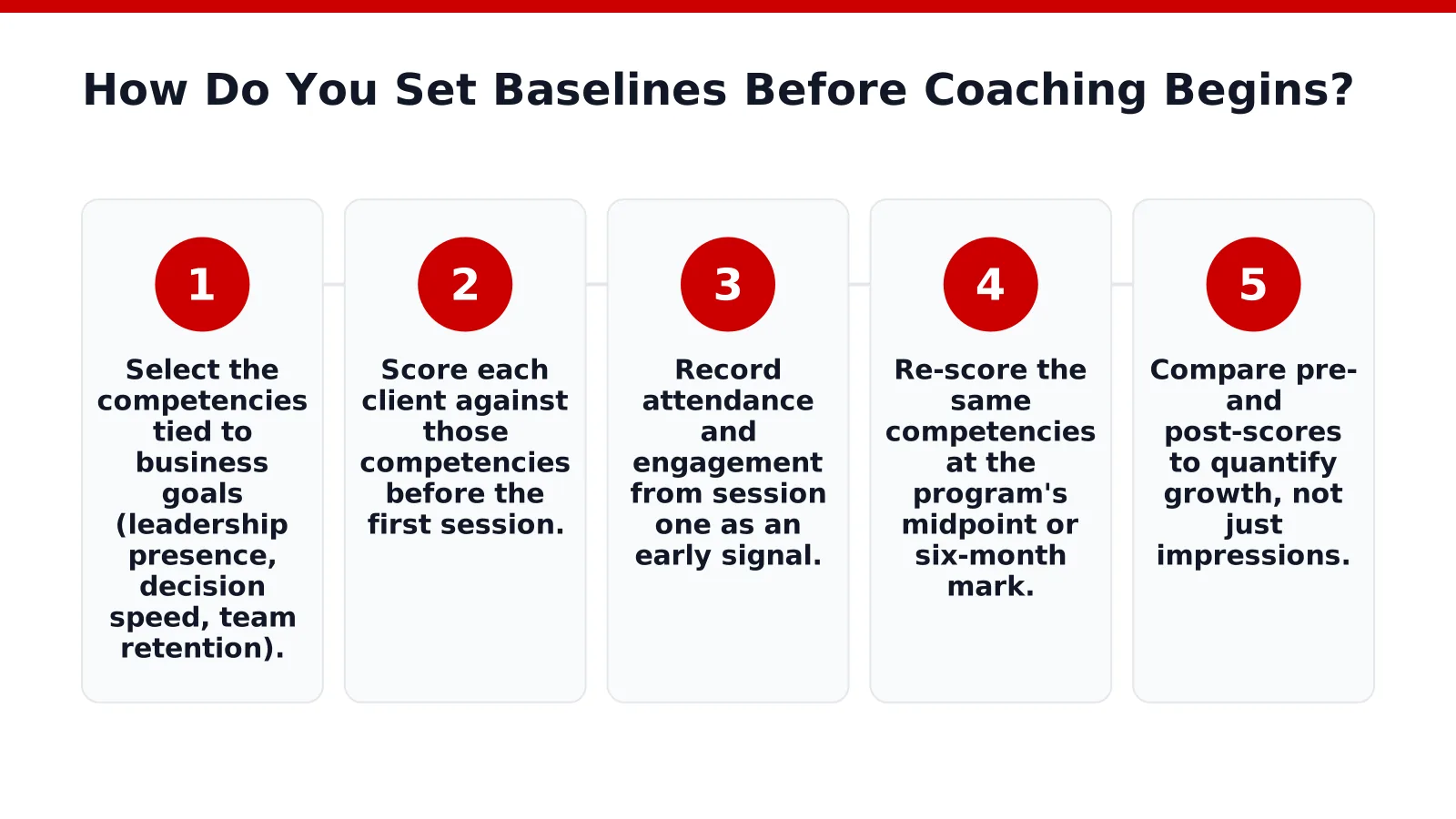
How Do You Set Baselines Before Coaching Begins?

Baselines get established through structured pre-coaching assessment, measured against the same competencies at defined checkpoints later. Skipping this step leaves Chief People Officers and L&D Directors guessing whether coaching caused a change or whether something else did. Without a starting measurement, organizational development leaders cannot separate coaching impact from normal performance drift, and budget justification becomes guesswork instead of evidence in the effort to measure coaching roi.
A credible coaching metrics guide treats baseline-setting as the first of three evidence layers, not an afterthought. Boon's framework for how to measure coaching ROI calls for leading indicators within weeks, competency growth over months, and business outcomes tracked across six to eighteen months. Baselines anchor that entire sequence.
Executives can follow this sequence when launching a program:
- Select the competencies tied to business goals (leadership presence, decision speed, team retention).
- Score each client against those competencies before the first session.
- Record attendance and engagement from session one as an early signal.
- Re-score the same competencies at the program's midpoint or six-month mark.
- Compare pre- and post-scores to quantify growth, not just impressions.
What counts as a reliable baseline measurement?
A reliable baseline uses the same competency framework before and after coaching, scored consistently across the whole cohort. Guesswork or informal manager feedback does not qualify. Programs built by coaches with decades of applied experience, including Lee Johnson's 20-plus years in the field, tend to design these frameworks with more rigor and incorporate leading coaching kpis standards.
Why does timing of the baseline matter?
Timing matters because scores taken after coaching starts get contaminated by early progress. Setting the baseline before session one, then re-measuring after a defined cycle, keeps the comparison honest and the resulting coaching KPIs defensible to finance and leadership stakeholders.
How Do You Track Leading Indicators Early On?

Session attendance offers the fastest proof that a coaching investment is working, visible from the very first meeting. HR executives don't have to wait months for a verdict. Early signals start accumulating immediately, long before competency scores or business outcomes materialize, strengthening a comprehensive coaching metrics guide.
What counts as a leading indicator in coaching?
Leading indicators are the fastest-moving data points available, often surfacing within weeks rather than months. Attendance is the clearest example: a client who shows up consistently from session one signals engagement that tends to predict later results. Boon's research on coaching metrics guide frameworks places leading indicators as the first of three evidence layers, ahead of competency growth (measured over months) and business outcomes (tracked across 6 to 18 months).
Tracking these signals well requires a sequence, not guesswork. Follow these steps:
- Capture attendance from session one. Record participation immediately so gaps surface early, not after a quarter has passed.
- Log engagement quality, including whether clients arrive with goals or follow through on commitments between sessions.
- Review patterns every few weeks. Don't wait for a formal evaluation period to spot disengagement.
- Pair attendance data with client satisfaction signals. A strong public reputation, such as a 5.00 star rating across 14 Google Reviews, reflects the kind of consistent engagement worth tracking from day one.
Beyond attendance, a few specific tools consistently surface early signal worth tracking:
- Structured coaching programs, which provide guidance and strategies clients can act on between sessions
- Self-assessment tools, letting clients evaluate their own skills, mindset, and progress on a regular cadence
- Feedback mechanisms, where mentors or peers offer outside perspective on a client's development
- Goal-tracking methods, used to set, monitor, and adjust objectives as the engagement progresses
Why does early tracking matter for reporting to leadership?
Waiting for six-month outcomes to prove coaching value leaves L&D directors with nothing to report in the interim. Early attendance and engagement data give Chief People Officers a defensible talking point while longer-term coaching kpis mature into measurable results.
How Do You Measure Competency Growth Over Time?

Competency growth shows up months after a coaching engagement starts, not days. Organizations that track only attendance or satisfaction scores miss the layer that actually proves development happened. A solid coaching metrics guide treats this middle layer as the bridge between quick leading indicators and long-term business results.
Leadership coaching speeds up how quickly leaders build critical skills, and competency assessments exist specifically to capture that acceleration. For HR executives building the case for continued investment, this is the data point that resonates most with skeptical finance partners. Numbers tied to skill development carry more weight than anecdotes about "feeling more confident" in a quarterly review.
Programs structured around a six-month cycle have published average competency growth of +23%, measured against baselines set before coaching begins. That figure comes from comparing a pre-coaching skills baseline to a post-program assessment using the same criteria. Organizational Development leaders can apply this model with four steps:
- Set a competency baseline before the first coaching session.
- Define the specific skills under development, such as decision-making or delegation.
- Re-assess against the same criteria at the program's midpoint and close.
- Report growth at the program level to protect individual confidentiality.
What counts as a competency, exactly?
Competencies cover observable leadership behaviors: strategic thinking, communication under pressure, delegation, and conflict resolution. Vague labels like "leadership presence" don't measure well. A strong coaching kpis framework defines each competency in behavioral terms before coaching starts, and that precision is what makes the later comparison credible. Program leaders who want to measure coaching roi accurately should treat this six-month competency layer as non-negotiable, since it's the evidence that turns soft development work into a defensible budget line.
How Do You Calculate Business Outcomes and ROI?

Business outcomes get calculated by connecting coaching activity to measurable organizational results over a defined window, not by guessing at correlation. Coaching ROI measures the business impact of investing in one-on-one or group coaching programs. That impact has to be tracked deliberately to count as evidence rather than anecdote, which is why many organizational development leaders borrow a four-level framework adapted from the Kirkpatrick and Phillips evaluation models: Reaction (did the executive find the coaching valuable, captured through post-session feedback and relevance ratings), Learning (what new capabilities or skills were actually developed), Behavior (whether those new skills show up in observable, on-the-job actions), and Results (the business impact itself, including retention, productivity, and promotion outcomes). That final level is where the strongest evidence lives: industry research on leadership coaching has found that 85% of coached high-potential leaders are promoted within 18 months, a data point that makes the business case for coaching far harder to dismiss. Organizational development leaders who skip this step end up defending coaching budgets with stories instead of numbers, which rarely survives a budget review.
The final evidence layer in any solid coaching metrics guide links coaching directly to business outcomes across a 6 to 18 month window. That timeframe matters. Leadership skills take months to show up in performance reviews, retention data, or revenue figures, so rushing the evaluation produces misleading conclusions.
What counts as a business outcome from coaching?
Business-level payoff from coaching shows up as measurable gains in employee performance, leadership development, and organizational effectiveness. HR executives tracking these outcomes should look for shifts in promotion readiness, team engagement scores, and manager retention rather than vague "improvement."
Is ROI the same as behavior change?
No. Calculating coaching ROI's monetary value is a separate exercise from tracking the behavioral and organizational changes coaching produces. Both deserve attention, but conflating them muddies the report.
A practical calculation sequence looks like this:
- Define the target business metric before coaching begins (retention, revenue per manager, promotion rate).
- Capture a baseline measurement.
- Re-measure at the 6 to 18 month mark.
- Compare the shift against cost to express true ROI.
Following that sequence keeps leaders from overstating coaching's value or missing it entirely and ensures the coaching kpis data is accurate.
Coaching ROI breaks down into two evidence types, and a defensible report tracks both rather than leaning on one alone.
What Mistakes Sabotage Coaching ROI Measurement?

Faulty measurement, not weak coaching, sabotages most ROI reports. Boon's framework analysis points to a blunt truth: proving coaching's value is genuinely hard, and that difficulty pushes many organizations toward numbers that look good on paper but don't hold up under scrutiny. The most common mistakes all trace back to skipping structure in favor of shortcuts, undermining the integrity of coaching metrics guide frameworks.
Why do organizations end up with inflated coaching ROI numbers?
Teams without a layered evidence framework often reach for a single flattering statistic instead of tracking progress across time. Boon's research describes this exact pattern: measurement is so hard that many programs end up fabricating their results rather than building toward them honestly. Skipping early indicators and skipping competency tracking leaves only a vague final claim, one nobody can verify.
Three mistakes show up again and again:
- Measuring once, at the end, instead of tracking leading indicators within the first weeks of a program.
- Reporting at the individual level, which breaks confidentiality and discourages honest participation in sessions.
- Rushing client intake, which stretches coaching capacity thin and weakens data quality across every cohort.
How does confidentiality affect coaching measurement?
Confidentiality protects honesty, and honesty protects the data. Reporting outcomes at the program level, rather than naming individual sessions, keeps each coaching relationship private while still generating usable, aggregate results.
VIP Coach builds this same discipline into intake. Accepting only 3 new clients per month protects the integrity of every measurement cycle. Smaller cohorts allow cleaner baselines and steadier tracking. A coaching metrics guide built on restraint, not volume, is what lets organizations actually trust the ROI figures they report to leadership and reliably measure coaching roi.
FAQ
What does a coaching ROI framework accomplish?
It delivers a tailored measurement plan, a defensible business case, and a repeatable coaching metrics guide that leadership teams reuse every cycle to justify program budgets.
What do executives need to approve coaching budgets?
Executives require a clear business case showing measurable return tied to coaching investment, with coaching KPIs translating soft development gains into numbers finance teams respect.
Which metrics prove coaching effectiveness?
Client satisfaction, productivity gains, reduced turnover, and employee engagement count as real evidence, alongside behavioral benchmarks like 360-degree feedback and retention and promotion rates.
Conclusion
In closing, the discipline of measuring coaching ROI separates programs that justify their budgets from those that disappear in the next round of cuts. You've now seen how layered evidence, competency growth, business outcomes, and honest tracking across time, builds the case that transforms coaching from a nice-to-have into a strategic investment. The work is rigorous. That rigor is exactly what earns leadership's trust and keeps your coaching initiatives funded for the long haul.
Contact VIP Coach
- 📞 Phone: (571) 605-1484
- ✉️ Email: [email protected]
- 📅 Clarity Call: Book a Free Clarity Call with Coach Lee
- 🌐 Website: transformwithvip.com
- 📍 Service Area: Sterling, VA and surrounding areas
About the Author
Lee Johnson founded VIP Coach and holds a Master Certified Life & Career Coach credential, the result of more than 20 years spent coaching executives and leaders toward measurable growth. That depth of experience is paired with a background as a seasoned real estate investor, giving Lee a practical, results-focused lens that shows up in every session. Lee's mission is simple: help people achieve financial freedom and happiness, which is also why VIP Coach keeps intake selective, taking on just three new clients a month to protect the quality and attention behind every engagement.