Measuring Coaching ROI: Track Your Career Impact
Measuring Coaching ROI: Track Your Career Impact
Wealth ROI from career coaching gets measured by tracking concrete financial shifts: salary increases, new passive income streams, and diversified investments against coaching fees paid. VIP Coach clients pair one-on-one coaching with financial goal-setting, comparing pre-coaching income and net worth to post-coaching results over defined periods, typically six to twelve months, for clear, evidence-based comparison.
Key Takeaways
- Executive coaching delivers 788% return on investment through productivity gains and improved employee retention rates.
- Career coaching measurably increases leadership performance, employee engagement, and organizational results across all industries.
- Track ROI by monitoring salary increases, promotions, retention rates, and productivity improvements post-coaching engagement.
- Lee Johnson's Master Certified coaching transforms career trajectories, with VIP Coach accepting only three clients monthly.
What Will You Accomplish by Measuring Coaching ROI?
Measuring coaching roi delivers a clear answer: professionals see which specific actions move income, title, and confidence forward together. Career and financial coaching aims to produce measurable wealth growth alongside real qualitative shifts in how clients lead, negotiate, and plan, not one at the expense of the other. A structured review turns vague progress into evidence executives can actually point to, whether you're working with VIP Coach from Sterling, Tysons, Arlington, or anywhere else across Northern Virginia and the DC metro area.
Why does tracking results matter for executives and high earners?
Busy professionals rarely have time to guess at what's working. Outside research backs the stakes: a Metrix Global study found that executive coaching return on investment reached 788%, driven largely by productivity gains and stronger employee retention. Skipping measurement means leaving that kind of upside invisible, even when the coaching itself is producing real results.
What does a results-focused coaching engagement track?
A results-focused engagement follows a short set of markers rather than one vague feeling of "progress":
- Income growth and new passive revenue streams
- Career milestones reached, like promotions or expanded responsibility
- Leadership and communication improvements noticed by peers
- Consistency of accountability habits over time
Many professionals struggle to balance demanding jobs with ambitious financial goals, which is exactly why this kind of structured tracking matters. Without it, busy executives often can't tell whether a coaching investment is paying off or just feeling productive.
VIP Coach guides executives, entrepreneurs, and high earners past career plateaus using credentialed methods and structured accountability, built to measure coaching impact in concrete terms rather than guesswork. That process is how Transform with VIP turns ambition into tracked, repeatable outcomes. For professionals ready to unlock your potential, measurement isn't an afterthought. It's the proof that the work is actually paying off.

What Tools and Baselines Do You Need First?
A clear baseline, not a guess, makes coaching roi measurable from day one. Before tracking anything, professionals need a starting snapshot of performance, income, and goals. Evidence-based strategies and expert guidance replace vague impressions with numbers that actually hold up over time.
Three elements build that baseline:
- Set the starting metrics. Record current income, savings rate, promotion timeline, or leadership scores before the first session.
- Choose a measurement framework. A structured evaluation framework, the kind outlined in established coaching literature, provides a practical method for tracking outcomes rather than relying on feelings alone.
- Define personal success markers. Because coaching works best when tailored to individual needs and goals, the markers that matter for an executive chasing a promotion differ from those for someone building passive income.
What counts as a good baseline metric?
A good baseline combines hard numbers with softer indicators. Income, savings rate, or team performance scores work well as hard data points. Confidence levels, communication quality, and goal clarity round out the picture. executive coaching return on investment rarely shows up in financial figures alone.
How do professionals track progress after the baseline is set?
Progress tracking works best when it blends several data types rather than one. Combining business performance numbers, personal feedback, and financial results gives a far more complete read than any single metric could offer. That blended model, borrowed directly from how organizations evaluate coaching, helps professionals measure coaching impact across both career and wealth-building goals, quarter after quarter.
How Do You Set Your Pre-Coaching Baseline?

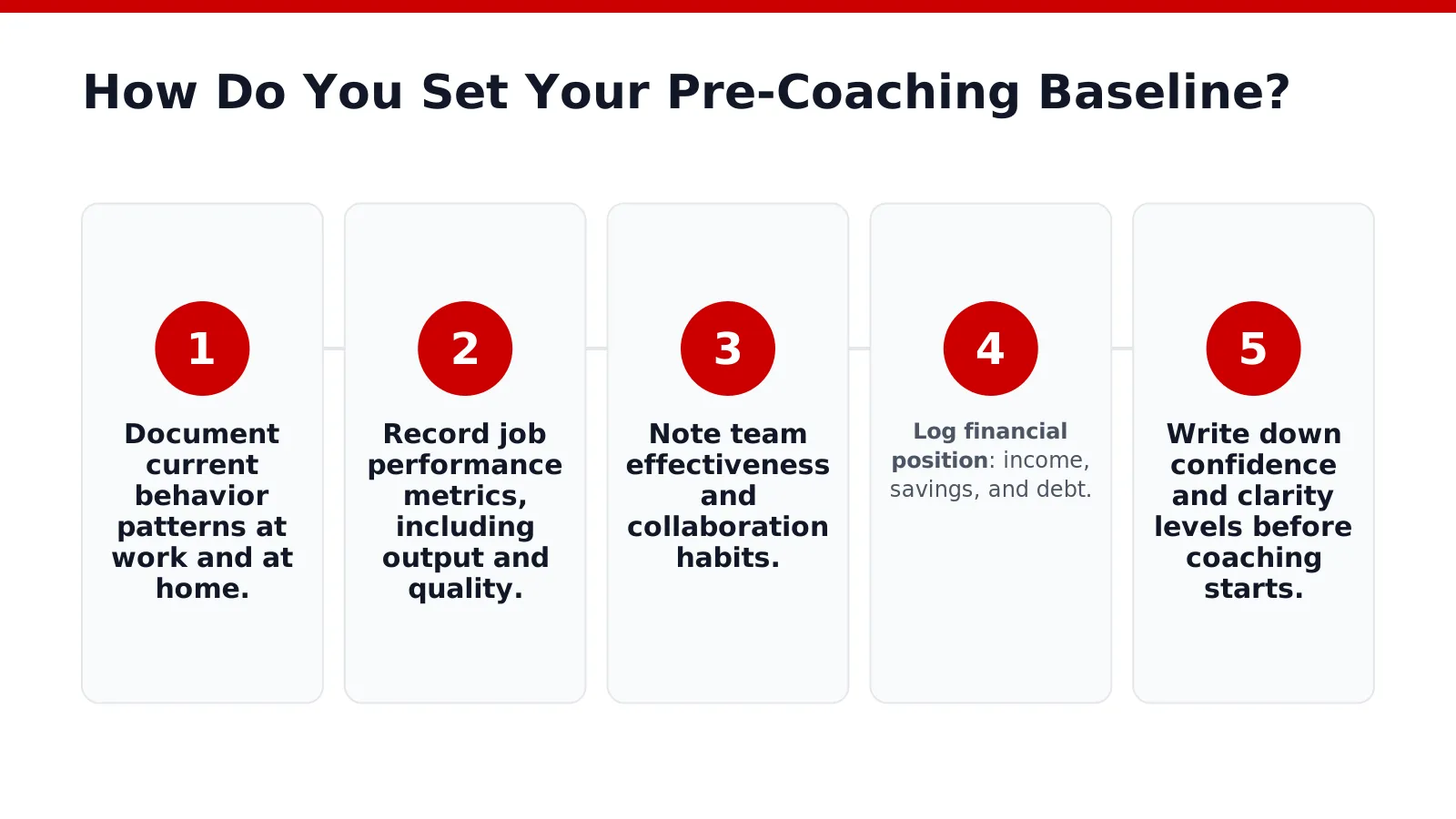
A pre-coaching baseline starts with an honest snapshot of where a professional stands right now, before any goals get set. Most executives arrive at coaching carrying a gap between where they are and where they want to be, often rooted in unclear direction, shaky confidence, or a strategic plan that never got written down. Naming that gap on paper, before session one, becomes the fixed point every future measurement gets compared against.
What Should the Baseline Actually Measure?
A solid baseline captures behavior patterns, job performance, and team effectiveness as they exist before coaching begins. These three categories give a coach and client a shared starting line, making it possible to measure coaching impact later with real comparisons instead of guesswork. Skipping this step is the single biggest reason coaching gains get written off as "vague improvement" instead of documented growth.
Financial goals deserve the same treatment. Building wealth while holding down a full-time role is a struggle shared by countless mid-career professionals. That tension belongs in the baseline record too. Clients working toward passive income or investment goals should log their current savings rate, debt load, and income streams alongside their career metrics.
Establishing this starting picture benefits from experienced guidance. Lee Johnson, who brings over two decades of coaching experience to this work, helps professionals pinpoint exactly where they stand before any strategy gets built. That clarity becomes the backbone of coaching roi calculations. The foundation of executive coaching return on investment tracking down the line.
- Document current behavior patterns at work and at home.
- Record job performance metrics, including output and quality.
- Note team effectiveness and collaboration habits.
- Log financial position: income, savings, and debt.
- Write down confidence and clarity levels before coaching starts.
Ready to pursue measurable transformation? Transform with VIP and get the structured baseline needed to unlock your potential with confidence.
How Do You Track Salary and Income Growth?

Salary growth becomes measurable the moment a professional connects compensation changes to specific coaching milestones instead of vague career momentum. Executives who track this way turn abstract progress into a clear record of coaching ROI, one raise or promotion at a time. Skipping this step leaves real earnings gains invisible, buried in annual reviews that rarely explain why pay actually moved.
Strategic career positioning plays a central role here. Coaching unlocks earning potential by helping clients identify personal strengths and position them where they carry the most market value. That strategic alignment, not just working harder, often explains why compensation moves after a coaching engagement begins.
What should professionals track to measure coaching impact on income?
A simple log works better than memory. Professionals aiming to measure coaching impact on income should record:
- Base salary at the start of coaching and at each review period.
- Bonus or commission changes tied to new responsibilities.
- Promotions or title changes following strategic repositioning.
- New revenue generated under the client's leadership, since revenue increases rank among the recognized executive coaching return on investment metrics and often mirror personal earnings growth.
Does income growth stop at salary?
No, salary is only part of the picture. Coaching that pairs passive income ideas with diversified investment strategies gives professionals a fuller income-growth picture to track beyond the paycheck. Combining salary data with passive income streams and investment returns shows the complete financial trajectory, not just the employer-driven slice of it.
How Do You Measure Net Worth and Cash Flow?

Net worth and cash flow get measured through quarterly tracking of assets, debts, and income streams against a documented baseline, a cadence that's frequent enough to catch problems early yet spaced out enough to reveal real trends instead of noise. Professionals who skip this step often mistake a higher salary for actual financial progress, when the two don't always move together; sustainable financial growth while holding down a demanding job depends on proven, research-grounded strategies that only mean something when someone checks the numbers on a regular schedule. Executives and high-earners already investing in coaching deserve a framework that scores more than career titles or promotions.
What should mid-career professionals track each quarter?
A clear review covers four areas:
- Total assets - savings, retirement accounts, real estate, and investment holdings
- Total liabilities - mortgages, loans, and outstanding credit balances
- Passive income streams and investment options - rental income, dividends, royalties, and portfolio growth, which coaches often treat as central levers for building measurable net worth
- Monthly cash flow - income minus expenses, tracked separately from net worth since a high salary can still produce negative cash flow
Why does cash flow matter more than salary alone?
Salary measures what someone earns; cash flow measures what someone keeps. A professional earning a substantial income can still bleed money through lifestyle creep or poor debt management, which is why coaching conversations focus on movement, not just totals. One-on-one coaching built around personalized career and financial transformation treats this kind of tracking as the real scoreboard: progress gets measured by shifts in cash flow and net worth over time, not by job titles or headline numbers alone.
How Do You Score Qualitative Career Dividends?

Qualitative career dividends get scored by tracking specific behavior shifts, not just bank balances. Goal attainment stands out as a recognized marker of coaching success, one that belongs on the same scorecard as revenue growth. The qualitative benefits of career coaching sit alongside wealth coaching metrics on a complete scorecard, yet executives who track coaching ROI often stop at dollar figures, missing half the picture entirely.
A complete scorecard pairs hard numbers with softer, harder-to-fake signals. Consider these three dividend categories:
- Goal clarity: Did the executive define and reach specific milestones within a set timeframe?
- Collaboration quality: Are cross-team projects moving faster, with fewer stalled handoffs?
- Confidence under pressure: Does decision-making happen faster, with less second-guessing?
Improved collaboration deserves its own line item. It compounds quietly, strengthening negotiations, team buy-in, and long-term career positioning in ways that show up months later on a performance review.
What Does "Qualitative ROI" Actually Look Like Day to Day?
Qualitative ROI shows up as clearer communication in meetings, faster conflict resolution, and fewer repeated mistakes. VIP coaching targets the root pain points behind stalled careers: foggy goals, shaky confidence, and missing strategy. Expert guidance replaces guesswork, helping clients unlock their true capabilities instead of relying on willpower alone.
Can Mindset Shifts Be Measured Like Financial Metrics?
Mindset shifts get measured through behavior change over time, not a single test score. Rewiring limiting beliefs merges financial independence with genuine psychological breakthroughs, a dividend worth logging monthly. Executives who measure coaching impact this way often notice decision speed and risk tolerance shifting before income does. Transform with VIP treats these inner shifts as real, trackable assets.
How Do You Calculate Your Total Coaching ROI?

Calculating coaching ROI takes more than a single number on a spreadsheet. The true financial impact of coaching includes tangible results like income growth and promotions. Intangible wins, such as sharper decision-making and stronger leadership presence, count just as much toward a complete picture. Professionals who only track dollars often miss half the story.
A clear framework helps separate signal from noise. Executives and high-earners who want to measure coaching impact accurately benefit from a structured, multi-dimensional process rather than a single metric, and understanding how to calculate coaching success this way means understanding career coaching return on investment in full. Here's a practical sequence to follow:
- Set a baseline. Document income, title, and key performance metrics before coaching begins.
- Define success markers. Include both financial goals (raises, revenue, savings rate) and behavioral goals (communication, confidence, clarity).
- Track intangible shifts. Note changes in decision quality, stress levels, and relationship dynamics at work.
- Review progress quarterly. Compare current standing against the baseline using both hard numbers and self-assessment.
- Calculate combined ROI. Weigh career and financial gains alongside personal growth indicators for a full result.
What counts as a tangible coaching result?
Tangible results include measurable financial and career outcomes: salary increases, bonus growth, promotions, or new revenue streams from a side business. These are the easiest wins to quantify and track over time.
What counts as an intangible coaching result?
Intangible results cover shifts in mindset, communication, and leadership presence that don't show up on a pay stub but shape long-term success. A Master Certified Life & Career Coach guiding structured accountability sessions helps clients organize both categories into one coherent evaluation, so no gain, financial or personal, gets overlooked.
Tangible vs. Intangible Coaching Results
Here's how the two categories stack up side by side:
What Mistakes Derail Accurate ROI Tracking?

Three errors consistently throw off coaching ROI calculations: skipping outcome evaluation, choosing volume-based coaching over personalized attention, and overlooking a coach's track record and credentials, and each mistake compounds the others, leaving executives and high-earning professionals with numbers that look impressive but mean little. The biggest trap is treating coaching sessions as a standalone activity instead of linking them to measurable business results: skipping evaluation that connects sessions to productivity gains and leadership improvement produces an incomplete picture, and professionals who only track session attendance or satisfaction scores miss the deeper data that actually proves executive coaching return on investment.
Does coach availability affect measurement quality?
Coaches who spread attention across too many clients at once struggle to track individual progress with precision. VIP Coach addresses this by accepting only a limited number of new clients each month, which supports the kind of focused attention accurate measurement requires. Fewer clients means more consistent check-ins, clearer benchmarks, and data that holds up to scrutiny.
What should professionals check before trusting a coach's results?
Reputation matters more than professionals often assume when they try to measure coaching impact. A coach with a perfect star rating built on genuine client reviews, like VIP Coach's 5.00-star standing on Google, signals consistent outcomes across a real client base, and credentials matter just as much. Working with a credentialed coach, such as a Master Certified Life & Career Coach, keeps the tracking process disciplined rather than anecdotal; skipping these checks, whether around availability, reputation, or certification, is often what derails ROI tracking before it even begins.
FAQ
How do you measure wealth ROI from career coaching?
Track concrete financial shifts like salary increases, new passive income streams, and diversified investments against coaching fees paid. Compare pre-coaching income and net worth to post-coaching results over a defined period, typically six to twelve months.
What specific markers does a results-focused coaching engagement track?
A results-focused engagement follows income growth and new passive revenue streams, career milestones like promotions, leadership and communication improvements noticed by peers, and consistency of accountability habits over time.
What do you need before you start tracking coaching ROI?
Establish a clear baseline by recording current income, savings rate, promotion timeline, or leadership scores before the first session. This starting snapshot replaces vague impressions with numbers that hold up over time.
Conclusion
In closing, measuring your coaching ROI means honoring both the numbers and the shifts that numbers can't capture. When you track income growth alongside decision-making speed, leadership presence, and the confidence that lets you move without second-guessing, you're building a complete picture of what coaching actually delivers. The professionals who see the biggest returns aren't chasing a single metric, they're committed to the structured, multi-dimensional approach that reveals the full scope of their transformation. Your investment in coaching compounds when you measure it honestly.
Contact VIP Coach
- 📞 Phone: (571) 605-1484
- ✉️ Email: [email protected]
- 📅 Consultation: Book a Consultation
- 🌐 Website: transformwithvip.com
- 📍 Service Area: Sterling, VA and surrounding areas
About the Author
Lee Johnson founded VIP Coach and brings over two decades of coaching experience to the practice, working with executives, entrepreneurs, and high earners on career growth and wealth strategy. Lee holds a Master Certified Life & Career Coach credential, a distinction that shapes the structured, accountability-driven approach behind every VIP Coach engagement.
Beyond coaching, Lee's background as a seasoned real estate investor informs the financial side of the work, helping clients connect career progress to real, measurable wealth building. That combination of credentialed coaching expertise and hands-on investing experience is what drives Lee's mission: helping ambitious professionals achieve lasting financial freedom and genuine happiness, not just a bigger paycheck.