Mental Resilience Toolkit for High-Pressure Roles
Mental Resilience Toolkit for High-Pressure Roles
A Mental Resilience Toolkit for high-pressure roles equips senior executives and fast-paced leaders with structured coping strategies for workplace stress, tight deadlines, and constant connectivity. VIP Coach, a Sterling, VA-based coaching practice serving professionals nationwide, builds personalized resilience frameworks addressing work as the top-cited workplace stressor, converting burnout risk into sustained high performance.
Key Takeaways
- Resilience develops through intentional practice and strategic skill-building in high-pressure environments.
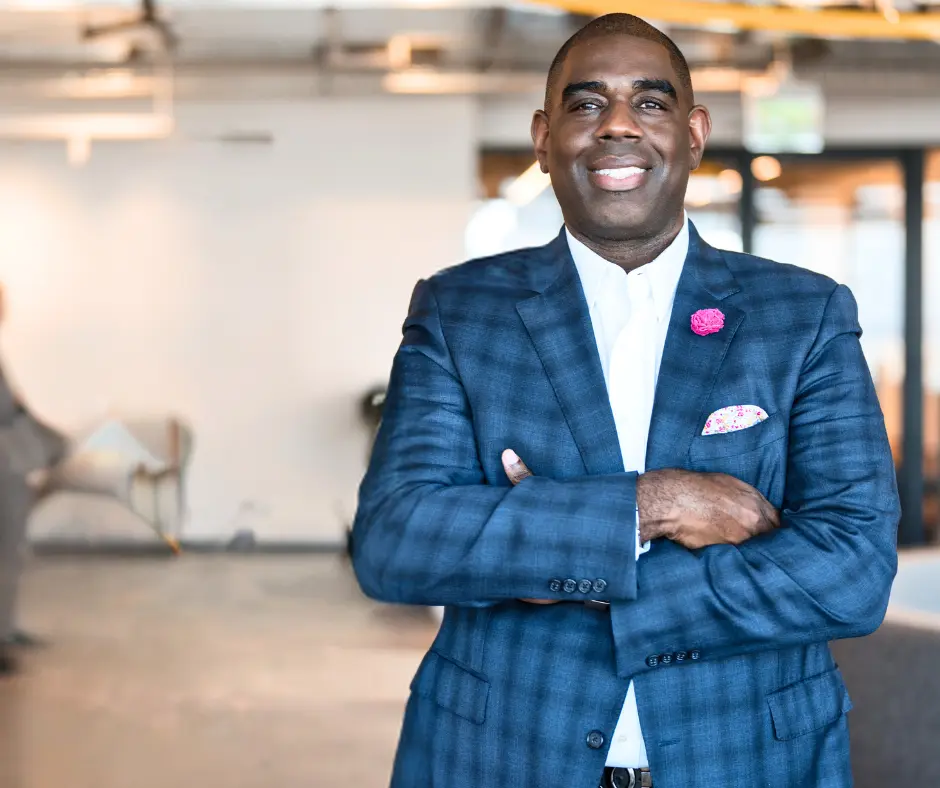
- Lee Johnson, Master Certified Life & Career Coach, guides professionals through resilience development.
- Mental resilience directly reduces stress and burnout from constant connectivity and tight deadlines.
- VIP Coach accepts only 3 new clients monthly to ensure personalized resilience coaching.
Why Does Mental Resilience Matter in High-Pressure Roles?
Work tops the list as the number one stressor in people's lives, according to a workplace mental health report from Mental Health America. That single fact explains why resilience can't stay optional for leaders, financial professionals, healthcare teams, engineers, and operations executives. These fields share one trait: long hours paired with sky-high expectations, where the stakes rarely feel small. Technical skill alone doesn't carry professionals through that kind of pressure.
High-pressure careers demand something deeper than expertise. They require a genuinely resilient mindset, one built to absorb setbacks and keep moving. Without it, the daily grind of tight deadlines, nonstop notifications, and constant availability chips away at focus and health.
What causes burnout in demanding careers?
Burnout rarely comes from one bad day. It builds from a fast-paced culture: heavy workloads, tight deadlines, tangled work relationships, and phones that never seem to stop buzzing. Add constant connectivity through mobile devices, and the mind never gets a real break.
Can resilience actually be developed?
Yes, resilience functions as a trainable skill, not a fixed trait someone either has or lacks. A well-built mental resilience toolkit gives professionals practical ways to recover from setbacks instead of simply pushing through them.
Executives who prioritize resilience at work tend to handle high-stakes decisions with steadier judgment. The right professional resilience tools turn daily pressure into something manageable, roughly outlined below:
- Structured recovery habits between high-stakes projects
- Mindset practices for staying grounded under scrutiny
- Boundaries that protect focus during long-hour stretches
Building that foundation helps professionals unlock their potential instead of burning through it.
What Is a Mental Resilience Toolkit, Exactly?
A mental resilience toolkit refers to a structured set of mental, emotional, and behavioral skills that help professionals adapt to stress, setbacks, and change without burning out. For executives and leaders carrying constant deadline pressure, that toolkit becomes the difference between surviving a demanding quarter and thriving through it. The stakes are real: without deliberate skill-building, high achievers risk trading long-term performance for short-term output.
Mental resilience itself gets defined as the ability to adapt, recover, and maintain balance when adversity hits. That's not the same as grinding through exhaustion. Endurance alone wears people down over time, while true resilience protects wellbeing and keeps performance steady under demanding conditions.
Is Resilience the Same as Toughing It Out?
No, and this distinction matters enormously for leaders under constant pressure. Toughing it out relies on endurance, which often ends in exhaustion and diminished output. Resilience, by contrast, equips professionals to sustain performance and protect their wellbeing while still meeting high stakes.
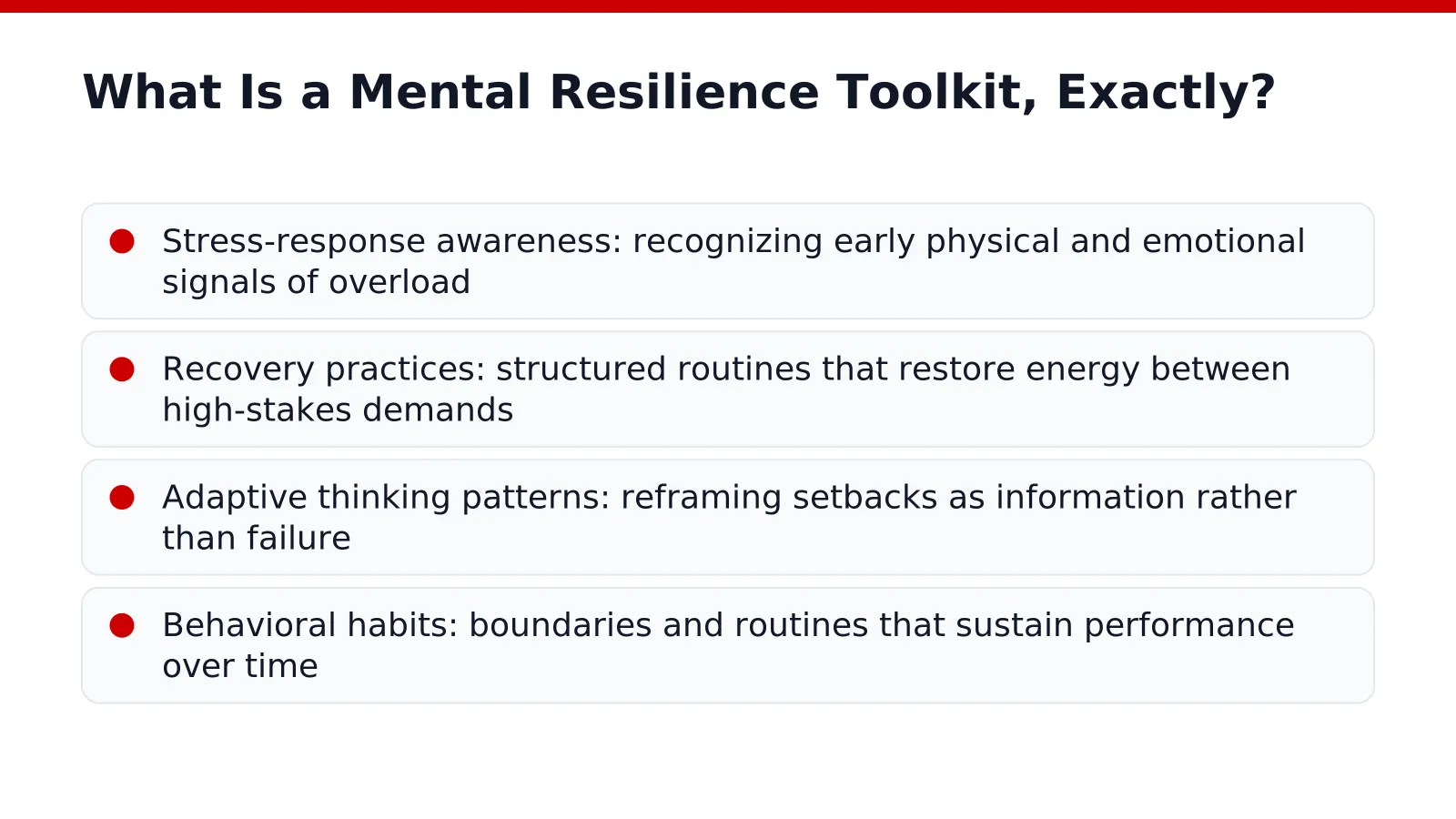
At its core, resilience comes down to adapting well to changes in one's environment, whether that's a shifting market, a leadership transition, or a sudden crisis. A well-built toolkit for resilience at work typically includes:
- Stress-response awareness: recognizing early physical and emotional signals of overload
- Recovery practices: structured routines that restore energy between high-stakes demands
- Adaptive thinking patterns: reframing setbacks as information rather than failure
- Behavioral habits: boundaries and routines that sustain performance over time
What Do Professional Resilience Tools Actually Include?
Professional resilience tools combine mindset practices with concrete behavioral strategies, not just motivational advice. These tools address thinking patterns, emotional regulation, and daily habits together. For professionals in high-pressure roles, that combination matters more than any single tactic, because sustainable performance depends on all three working in sync.

How Does Resilience at Work Actually Show Up?
Resilience at work looks less like grinding through a bad week. More like bouncing back from a major setback ready to lead again. Resilience: A Strong Workforce Needs It describes this as the ability to bounce back and thrive after major challenges, not simply survive them. For executives juggling board pressure, tight deadlines, and high-stakes decisions, that distinction matters. Surviving drains energy. Thriving builds it back.
On a practical level, resilience at work functions as a strategy, not a personality trait. It helps professionals tackle stress, navigate a competitive job market, and work through conflict without losing momentum. Leaders who carry a sharpened mental resilience toolkit into negotiations, restructurings, or crisis calls tend to recover faster from friction than those relying on willpower alone.
What does resilience look like day to day for a busy leader?
It shows up as adaptability. Resilient professionals adjust quickly when their work environment shifts, whether that means a sudden reorg, a market downturn, or a last-minute client demand. They don't freeze; they recalibrate.
A few concrete markers tend to appear consistently:
- Shifting priorities without losing sight of long-term goals
- Adjusting their approach when old methods stop working
- Embracing new technology or processes as job demands evolve
- Staying engaged with a team instead of withdrawing under pressure
Why does adaptability matter so much in high-pressure careers?
Because the pace rarely slows down. Leaders who embrace new professional resilience tools, whether structured coaching, deliberate recovery habits, or decision-making frameworks, stay flexible instead of brittle. VIP Coach is located in Sterling, VA, us. This helps them build exactly this kind of adaptive capacity so performance holds steady even when conditions don't.

What Professional Resilience Tools Should You Build First?
Four tools come first for leaders under constant pressure: self-care routines, stress-response regulation, reframing skills, and boundary-setting habits. Skipping these leaves high performers running on willpower alone. Willpower runs out fast when deadlines stack up and stakes stay high.
Caring for oneself on purpose, not as an afterthought, forms the base of any mental resilience toolkit. Deliberate self-care steps help executives handle emotional strain today and build a buffer against whatever pressure comes next. Skip this step, and even strong performers burn through their reserves faster than they can refill them.
What does it mean to build resilience at work instead of just pushing through?
Pushing through feels productive, but it isn't the same as building real capacity. Genuine resilience at work means learning repeatable skills: regulating stress responses before they spiral, reframing setbacks instead of absorbing them as failures, and recovering faster after a rough quarter or a brutal week. For executives in roles for High-Pressure Roles, that distinction separates leaders who sustain performance from those who flame out.
Which professional resilience tools matter most for executives?
A short list of professional resilience tools covers the essentials:
- Stress-response regulation: pausing before reacting under pressure
- Cognitive reframing: viewing setbacks as solvable problems, not threats
- Boundary-setting: protecting recovery time between high-stakes demands
- Relationship-building: leaning on supportive colleagues and mentors during tough stretches
These skills aren't abstract wellness talk. Resilience functions as a measurable, buildable skill set, and leaders who invest in developing it see real, trackable results in performance and retention. For professionals navigating High-Pressure Roles, VIP Coach brings coaching support directly to wherever that pressure lives, helping ambitious leaders unlock your potential without sacrificing their edge. That's the promise behind Transform with VIP: building tools that hold up when the stakes are highest.
How Do High Performers Handle Setbacks and Adversity?
Setbacks test executives in ways technical skill never does. High performers lean on resilience, the process of adapting well in the face of adversity or major stress, rather than sheer willpower. That distinction matters for anyone operating in high-pressure roles, where the next crisis is never far away.
Significant career disruptions rarely arrive one at a time. A failed product launch, a health scare, or a boardroom conflict can test a professional's resilience all at once. Serious life changes, health problems, and workplace stress all demand the same underlying skill: the ability to recover without losing footing.
What makes career setbacks so hard to bounce back from?
Major career challenges bring more than logistical headaches. They stir up a unique mix of thoughts, strong emotions, and uncertainty that no spreadsheet can resolve. A mental resilience toolkit helps executives name those reactions instead of being ruled by them, turning a chaotic moment into something workable.
Do people naturally recover from high-pressure setbacks?
Most people adapt well over time to stressful, life-changing situations, especially with the right support in place. Recovery isn't automatic, though. It depends on structure, accountability, and a plan built before the crisis hits.
High performers who practice resilience at work tend to share a few habits:
- They name the stressor instead of avoiding it.
- They separate what's controllable from what isn't.
- They lean on outside perspective rather than isolating.
- They treat recovery as a skill to build, not a trait they either have or lack.
Executive coaching provides exactly this kind of structure. VIP Coach builds professional resilience tools for leaders navigating high-pressure roles, no matter where those roles are based, helping clients steady themselves after setbacks and keep performing at the level their careers demand.
What Happens When Resilience Gets Ignored at Work?
Stress, fatigue, and burnout move in fast when high-pressure conditions go unmanaged, according to Building Mental Resilience for High-Pressure Careers. Leaders in finance, healthcare, law, and executive operations feel this first, since their roles rarely offer a pause button. Skipping resilience work doesn't just cost a bad week. It compounds, quietly draining judgment, patience, and physical health until a crisis forces the issue.
Executives often discover their own limits at the worst possible moment. Resilience: A Strong Workforce Needs It notes that resilience gets tested most sharply when stress factors pile up unexpectedly or when real tragedy hits without warning. Waiting for that moment to build coping skills is a losing bet.
Does ignoring resilience actually affect business results?
Yes, and the link is direct. Resilience Training in the Workplace: What HR Leaders Need to Know points out that how employees respond to constant pressure shapes organizational performance, retention, and culture. A leadership team that never addresses resilience risks turnover, slipping output, and a culture that feels brittle under stress.
Is resilience at work just a wellness trend?
No. The same research frames workplace resilience as a measurable priority rather than a wellness buzzword leaders can set aside. Treating it that way leaves real performance gains on the table.
Here's what tends to erode when resilience stays off the agenda:
- Decision-making quality under deadline pressure
- Team trust and retention over time
- Physical and emotional recovery between high-stakes projects
- Long-term career sustainability, not just short-term output
VIP Coach builds a mental resilience toolkit for professionals who operate at this altitude, wherever their career takes them. The goal isn't just surviving pressure. It's building genuine resilience at work with professional resilience tools designed to help clients unlock your potential before burnout forces the issue. That's the promise behind Transform with VIP.
How Can Structured Coaching Build Lasting Resilience?
Structured coaching builds lasting resilience by pairing proven frameworks with personal accountability instead of generic advice. For executives and leaders in high-pressure roles, that distinction matters more than motivation alone. VIP Coach serves professionals wherever those demanding roles exist, bringing a tested approach to leaders juggling tight deadlines, high-stakes decisions, and constant visibility.
At the center of that approach sits Lee Johnson, a Master Certified Life & Career Coach who works directly with high-performing professionals navigating relentless schedules and outsized expectations. Johnson brings over 20 years of coaching. Career experience to the table, shaping each engagement around the realities of demanding careers rather than one-size-fits-all scripts. That depth of experience matters when the stakes involve leadership credibility, team performance, and long-term career trajectory.
Why does VIP Coach limit how many clients it takes on?
VIP Coach intentionally caps new client intake at just 3 per month. Fewer clients means more attention, deeper customization, and coaching that actually fits a leader's specific pressures. This isn't about exclusivity for its own sake. It's about protecting the quality of a true mental resilience toolkit built for someone operating under constant demand.
Does the coaching approach actually hold up under scrutiny?
Client feedback suggests it does. VIP Coach maintains a 5.00 star rating based on 14 Google Reviews, a signal of consistent trust from professionals who've put the process to the test.
Structured coaching sessions typically focus on:
- Building resilience at work through decision-making frameworks suited to high-stakes environments
- Developing professional resilience tools that transfer across leadership transitions and new roles
- Creating accountability rhythms that outlast short bursts of motivation
- Aligning career ambition with sustainable daily habits
Leaders in demanding roles don't need more willpower. They need a structured system that holds up when the pressure doesn't let up.
What's Your Next Step Toward Sustainable High Performance?
Sustainable performance starts with a single conversation, not an overhaul of an entire career. For leaders drowning in back-to-back meetings, deadlines, and constant decision-making, the smallest first move often carries the most weight. Burnout rarely announces itself; it builds quietly until a reliable executive starts missing deadlines or losing patience with a team. That's the moment a mental resilience toolkit stops being optional and starts being essential.
How does coaching actually build resilience at work?
Coaching works by pairing someone who has lived the high-stakes life with a structured plan for recovery and growth. Lee Johnson, a coach, entrepreneur, and real estate investing advocate, brings firsthand understanding of career pressure and financial strategy to every session. He doesn't just teach theory. He's built businesses while managing the same stress executives carry into boardrooms every day.
That dual lens, performance and financial alignment, shapes how resilience at work gets taught. Clients leave sessions with frameworks they can apply immediately, not vague encouragement to "manage stress better."
What does getting started actually look like?
Reaching out is simple. Professionals can start the conversation by emailing [email protected], and scheduling fits around demanding calendars rather than fighting them.
- Monday through Friday: 10:00 a.m. to 5:00 p.m.
- Saturday mornings: 10:00 a.m. to 1:00 p.m.
That flexibility matters for executives whose weeks rarely follow a predictable rhythm.
Coaching sessions function as professional resilience tools, built to fit around travel schedules, board meetings, and the unpredictable demands of leadership. Those ready to unlock your potential don't need to wait for a crisis. Transform with VIP starts with one email, and the next step toward lasting, sustainable performance begins there.
FAQ
What causes burnout in high-pressure careers?
Burnout builds from a fast-paced culture of heavy workloads, tight deadlines, tangled work relationships, and constant connectivity through mobile devices. This nonstop pressure prevents the mind from getting a real break, gradually eroding focus and health.
Is mental resilience something people are born with?
No, resilience functions as a trainable skill rather than a fixed trait. A well-built mental resilience toolkit gives professionals practical ways to recover from setbacks instead of simply pushing through them.
Who leads resilience coaching at VIP Coach?
Lee Johnson, Master Certified Life & Career Coach and founder of VIP Coach, guides professionals through resilience development. VIP Coach accepts only 3 new clients monthly to ensure personalized coaching for each person.
Conclusion
In closing, building mental resilience isn't a luxury for high-pressure professionals, it's the foundation that separates burnout from breakthrough. The tools you've explored here work because they address both your mind and your capacity to perform at your best. You've got everything you need to transform pressure into purpose. The real work starts when you commit to practicing these strategies consistently, even when things feel manageable. That's where lasting change happens, and that's where you'll discover just how capable you truly are.