Transitioning to Fractional Leadership Coaching
Transitioning to Fractional Leadership Coaching
Transitioning to fractional leadership pivot coaching starts with structured accountability. Career strategy sessions, like those VIP Coach provides in Sterling, Virginia. Executives work through credentialed assessments, including MBTI, to clarify strengths, then build a portfolio-based plan replacing one 60-80 hour corporate role with multiple flexible, high-leverage consulting engagements.
Key Takeaways
- Fractional leadership deploys experienced C-suite executives across multiple organizations simultaneously on contract basis.
- Lee Johnson's Master Certified coaching reshapes individual leadership behavior, producing measurable results within weeks.
- Full-time executive roles demand 60-80 hours weekly; fractional models eliminate unsustainable on-call demands.
- VIP Coach accepts only 3 new clients monthly, ensuring personalized pivot coaching attention.
Why Are Executives Burning Out In Corporate Roles?
Corporate burnout stems from a workweek that never really ends. Senior leaders routinely clock 60 to 80 hours a week, staying on call for teams, fellow executives, and board members at every hour, according to Fike & Co. That math doesn't leave room for recovery, let alone a personal life. The traditional full-time leadership model simply wasn't built to sustain this pace.
Crisis accelerates the breaking point. Economic downturns, pandemics, and disruptive competitors regularly force companies to rethink how leadership gets structured, per Fractional Leadership Roles. When a market shifts overnight, the old 9-to-5, single-employer arrangement looks fragile fast. Executives who've spent years climbing the ladder suddenly find the ladder itself unstable.
What Signals Suggest It's Time To Rethink a Corporate Role?
Clarity gaps are usually the first warning sign. Many professionals hit a wall where uncertainty about direction, shaky confidence, or vague strategic goals stalls real progress toward their potential. That stall often shows up as exhaustion without results, a sense of running hard while standing still.
Does Burnout Mean a Career Change Is Necessary?
Not necessarily a full change, but a structural one. Executives exploring a transition to fractional roles or a pivot to consultant often find the issue isn't the work itself, it's the all-consuming container holding it. Reworking that structure, rather than abandoning a career entirely, tends to solve the exhaustion problem.
Fractional leadership coaching exists precisely for this crossroads. VIP Coach specializes in helping ambitious professionals break through career plateaus and build long-term financial freedom, using structured strategy instead of guesswork. For executives ready to unlock your potential and build something sustainable, Transform with VIP offers a starting point grounded in experience, not burnout math.
What Exactly Is Fractional Leadership?
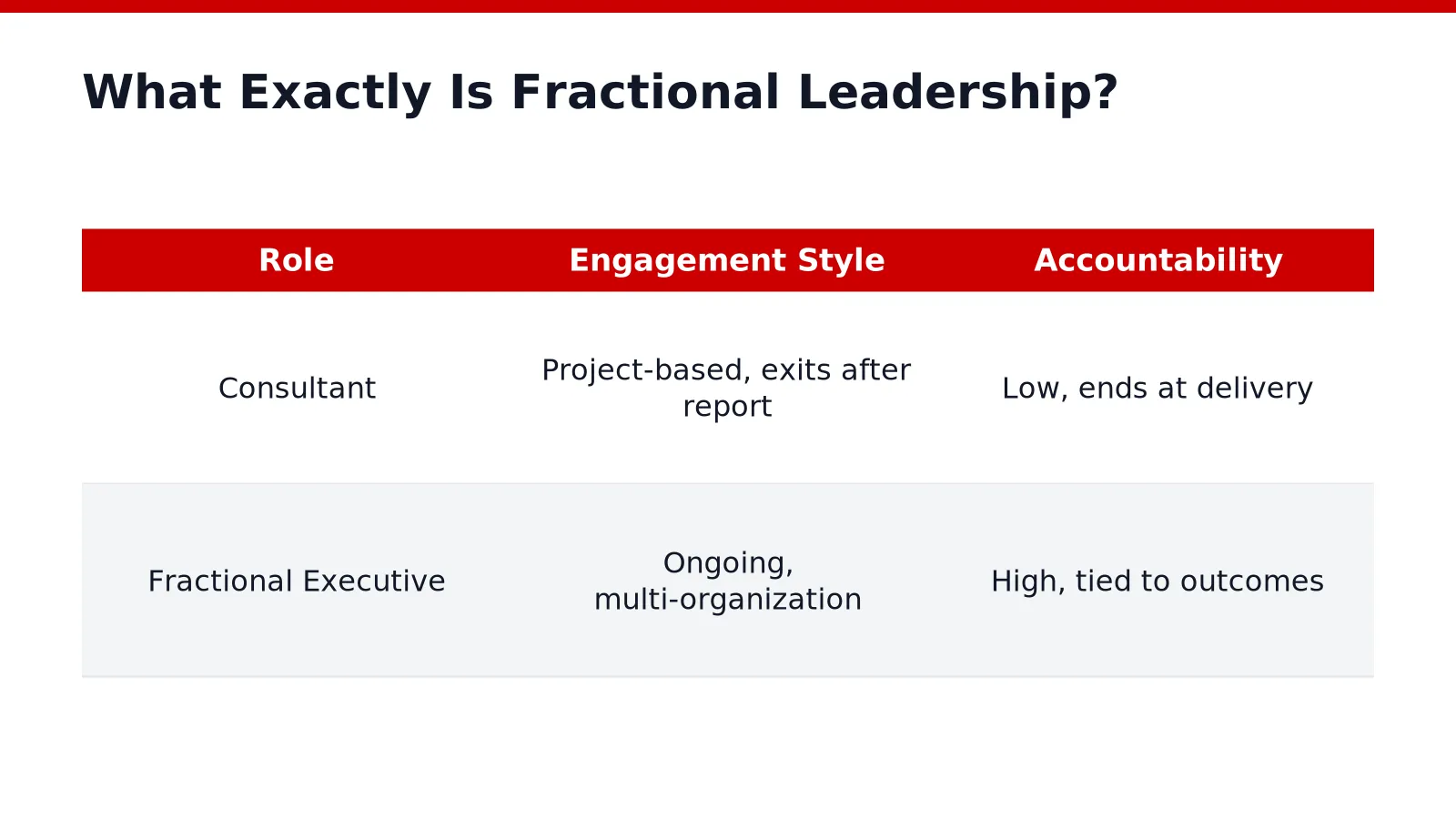
A fractional leadership coaching engagement centers on a specific kind of executive: a seasoned C-suite leader, think COO, CMO, or CTO, who provides strategic oversight to multiple organizations at once, under contract rather than a permanent title. This model has grown out of necessity. Senior leaders burned out by single-company demands are discovering a structure that lets expertise flow across several businesses instead of one.
The distinction between a fractional executive and a traditional consultant matters here. Consultants get hired to solve a narrow problem, hand over a report, and move on. A fractional leader stays embedded in the organization, carrying accountability for outcomes rather than recommendations. That difference shapes why so many senior executives weighing a pivot to consultant work eventually realize fractional leadership asks for deeper, ongoing ownership.
Fractional leader vs. consultant: what's the real difference?
A consultant's job ends at the report. A fractional leader's job continues through execution, team accountability, and measurable results over time. For executives considering the transition to fractional roles, this distinction determines how much operational involvement to expect week to week.
Companies turn to fractional leadership for a reason beyond flexibility. Engaging a fractional leadership consultant has proven itself as a cost-effective, strategic way for organizations stuck in a stagnant status quo to find renewed growth. That same mechanism, applied in reverse, gives corporate directors and VPs a credible exit ramp from plateaued 9-to-5 roles.
Lee Johnson, Master Certified Life & Career Coach, founded VIP Coach in Sterling, Virginia, building a practice around exactly this kind of career redirection.

How Is Fractional Coaching Different From Executive Coaching?
Executive coaching and fractional leadership coaching solve two different business problems. One rewires how a leader thinks and makes decisions. The other rewires the systems and structures around that leader, changing how work actually gets done across an organization.
That distinction matters more than most executives realize. A leader stuck on mindset, say, avoiding tough calls or struggling with delegation, needs coaching focused on behavior. A leader whose real bottleneck is organizational design, resourcing, or strategic oversight needs something broader. Picking the wrong tool wastes time; picking the right one moves the business forward with less friction and more confidence.
What problem does each approach actually solve?
Coaching reshapes an individual's decision-making patterns and leadership habits. Fractional leadership reshapes the systems, teams, and processes surrounding that individual. Executives weighing a transition to fractional roles need clarity on which problem they're solving before choosing a path.
Does VIP Coach focus on one or the other?
VIP Coach doesn't start with tactics. Every engagement begins with a client's core values. Goals built without that foundation tend to produce burnout and hollow wins, even when they look like success on paper.
Lee Johnson brings over 20 years of coaching experience to this exact crossroads, helping leaders diagnose which lever to pull. For executives considering a pivot to consultant work or fractional engagements, that diagnostic clarity often matters more than any single tactic. Values come first, strategy follows, and the business moves with far less drag.

How Do You Pivot From Full-Time To Fractional?
A successful pivot starts with pairing career strategy and personal development, not just updating a resume. Senior executives leaving a single-employer model need both a new business structure and a mindset shift to support it. VIP Coach builds this dual foundation for VPs. Directors across Northern Virginia who are ready to trade a single paycheck for a diversified portfolio of engagements.
Fractional leadership coaching works because it treats the transition as a full identity shift, not a side project. Credentialed methods like MBTI, combined with structured accountability, turn a vague ambition into a measurable plan. Stalled goals get unstuck when an executive finally sees the pattern behind the plateau.
What does the transition to fractional roles actually involve?
The transition to fractional roles means moving from one employer to several concurrent clients, each paying for strategic oversight rather than full-time presence. Executives have to rebuild how they price their time, market their expertise, and manage multiple priorities at once. This shift can feel disorienting without a guide who has mapped the territory before.
Lee Johnson, Master Certified Life & Career Coach, leads this process personally, bringing specialized executive coaching expertise to every engagement. That direct involvement matters. Executives working through a career pivot need someone who understands both leadership psychology and the practical mechanics of portfolio careers.
Is it hard to pivot to consultant work from a corporate title?
Yes, the hardest part isn't the skills, it's the identity shift. Executives who pivot to consultant or fractional work often struggle to let go of the security a corporate title provided. VIP Coach keeps intake to only a few new clients monthly, which means:
- Personalized attention throughout the transition
- Consistent accountability on goals and timelines
- Direct access to leadership development expertise
That structure helps clients unlock their potential instead of guessing their way through a career overhaul alone.
What Does Pivoting To Consultant Really Involve?
Pivoting to consultant means trading a single employer for a portfolio of client engagements, each with its own scope and finish line. Accountability shifts, too. A consultant sits outside the organization they serve, and according to The Death of the Full-Time C-Suite, that accountability ends at the deliverable rather than stretching into the open-ended obligations of a staff role. That distinction changes everything about how a senior leader structures their week.
For executives used to being on call around the clock, this boundary feels unfamiliar at first. Deliverables have edges. Jobs rarely do.
Why Does Diversified Income Matter For This Shift?
Relying on one employer in a volatile market carries real risk. Building multiple income streams, sometimes called a diversified income portfolio, removes that single-point-of-failure exposure tied to one paycheck. Senior leaders who spread their work across several clients protect themselves against the kind of sudden disruption a single layoff or reorg can cause.
How Does Coaching Support The Transition?
A structured coaching relationship gives this pivot shape instead of guesswork. One-on-one coaching offers personalized career and financial transformation support, built around individual goals rather than a generic playbook. That personalized, individually focused approach helps leaders design their own consulting path, one that fits their expertise, risk tolerance, and income targets.
Making the leap typically involves a few interconnected moves:
- Clarifying which deliverables translate into standalone consulting offers
- Pricing engagements around outcomes, not hours
- Building a client pipeline before leaving steady income behind
- Setting boundaries that preserve the deliverable-based accountability model
None of this happens by accident. Fractional leadership coaching gives executives a framework for sequencing these decisions instead of leaving them to chance, which is precisely where guided support earns its value during a high-stakes career transition.
How Do You Build A Diversified Income Portfolio?
Building a diversified income portfolio starts with separating salary from strategy. A single corporate paycheck ties an executive's entire financial future to one employer's decisions, one budget cycle, one reorg. VIP Coach, a premium life and business coaching practice built to help ambitious professionals maximize their full potential, approaches portfolio-building as a structured shift away from that single-point dependency.
The first move isn't finding a second job. It's learning what to do with the income already on the table. VIP Coach helps clients convert increased earnings into discretionary cash flow, the actual fuel for wealth building rather than just a bigger number on a pay stub. Without that conversion step, raises and bonuses quietly disappear into lifestyle creep instead of becoming capital.
What assets belong in an executive's income portfolio?
Portfolio income for a transitioning executive typically includes a mix of active and passive streams. Consider:
- Fractional leadership coaching engagements, applying C-suite expertise across multiple organizations part-time
- Advisory or board-level consulting work tied to specialized functional experience
- Real estate holdings, an asset class Lee Johnson champions as a real estate investing advocate based in Sterling, Virginia
- Equity or royalty positions built from prior career capital
Does company size affect the coaching support available?
Smaller firms often deliver closer, more personalized guidance. VIP Coach operates as a boutique practice with a team of three, a structure designed for direct relationships rather than call-center style support. That closeness matters when someone is rebuilding an entire income model, not just tweaking a résumé.
Clients working through a transition to fractional roles need both strategic mapping and real-world asset context. Pairing coaching with Johnson's real estate background gives executives a fuller view of how to pivot to consultant work while building equity on the side, ultimately helping them unlock your potential well beyond the confines of one job title. That combination is what makes the shift feel less like a gamble. More like a plan, one many describe as the moment they decided to Transform with VIP.
What Mistakes Derail A Fractional Leadership Transition?
Several missteps stall the move from corporate executive to independent operator before momentum ever builds. Skipping expert guidance tops the list. Leaders who go it alone often leave real capabilities unlocked but never put to use, stalling the shift instead of speeding it up.
A handful of patterns show up again and again among executives attempting fractional leadership coaching without a clear plan:
- Treating the move as a side project instead of a structured career strategy
- Holding onto corporate habits that don't translate to multi-client work
- Rushing into the first opportunity instead of weighing it against long-term fit
- Underestimating how much positioning and outreach the shift actually requires
Why Do Fractional Leadership Transitions Stall Out?
Transitions stall when leaders refuse to adapt their thinking to a genuinely new business model. Companies and individuals who resist that shift risk staying fragile instead of becoming agile. Fragile rarely survives a market downturn, let alone thrives in one. A leader attempting the transition to fractional roles with an old corporate mindset often recreates the same overload that pushed the exit in the first place.
What Does Choosing The Wrong Approach Cost?
Choosing the wrong strategic approach costs more than wasted effort. A misstep here can cost an entire quarter of lost momentum. The right choice lets the business, and the leader, move forward with less friction and more confidence. That gap is exactly why a structured pivot to consultant work benefits from aligned, personalized support rather than a one-size-fits-all playbook.
Executives who get that kind of aligned support tend to see it in their outcomes. That pattern shows up clearly in VIP Coach's perfect 5.00 star rating across 14 Google Reviews from executive and business coaching clients.
How Does VIP Coach Guide Your Pivot?
VIP Coach guides executives through fractional leadership coaching using structured accountability, decades of practical experience, and a deliberately small client roster. Senior leaders considering a transition to fractional roles get hands-on strategy sessions, not generic career advice. Burnout rarely fixes itself. Without a clear framework, a pivot to consultant work stalls for months or collapses under scope confusion.
Lee, VIP Coach's lead coach, built a reputation among clients for being easy to talk to and carrying a wealth of knowledge drawn from decades of practical, real-world leadership experience. That reputation shows up directly in client feedback. VIP Coach holds a perfect 5.00-star rating across 14 Google Reviews from executives. Business leaders who've navigated their own career transitions.
Capacity stays intentionally tight. VIP Coach accepts only 3 new clients per month, a limit designed to protect the depth of every engagement rather than maximize volume. That scarcity matters for executives weighing a jump into fractional work: each session gets real attention, not a rushed, templated conversation.
Where Is VIP Coach Located, and When Can Clients Reach the Team?
VIP Coach operates from its Sterling, Virginia office at 21000 Southbank St. Ste 106-380. Support runs Monday through Friday from 10:00 am to 5:00 pm, plus Saturday mornings from 10:00 am to 1:00 pm. Flexible hours matter when a career shift happens around a demanding, unpredictable schedule.
What Does the Pivot Actually Look Like Week to Week?
Sessions move through distinct phases: naming burnout triggers, mapping transferable skills, and building a portfolio of fractional engagements. Coaching typically focuses on:
- Identifying which leadership skills translate into paid fractional work
- Structuring pricing, contracts, and client boundaries for consulting
- Setting accountability checkpoints that stop old corporate habits from creeping back in
Each step runs through Lee's own operating experience, not borrowed theory. Clients leave sessions ready to unlock your potential, with a concrete next action instead of vague encouragement. That's the whole point behind Transform with VIP: turning a stalled plateau into forward motion, one deliberate session at a time.
FAQ
How does VIP Coach structure the fractional leadership pivot process?
VIP Coach uses structured accountability and career strategy sessions, including credentialed assessments like MBTI, to clarify executive strengths and build a portfolio-based plan replacing one demanding corporate role with multiple flexible consulting engagements.
What makes fractional leadership different from traditional consulting?
A fractional executive provides ongoing strategic oversight to multiple organizations simultaneously under contract. A consultant solves a narrow problem, delivers a report, and moves on.
Why does VIP Coach limit new client intake?
VIP Coach accepts only 3 new clients monthly, ensuring personalized attention during each executive's pivot coaching journey under Lee Johnson's Master Certified coaching approach in Sterling, Virginia.
Conclusion
In closing, transitioning to fractional leadership pivot coaching isn't just about adding a new service to your toolkit, it's about stepping into a role where your experience becomes the catalyst for someone else's breakthrough. You've got the expertise, the credibility, and the real-world wins to guide ambitious professionals through their most critical transitions. The path forward is clear: align your coaching with the transformation you've already lived, and watch as leaders who need exactly what you offer find their way to you.