Your 10-Year Wealth Plan to Financial Independence
Your 10-Year Wealth Plan to Financial Independence
(571) 605-1484[email protected]Book a Free Clarity Call with Coach Leetransformwithvip.com
A decade-long 10 year wealth plan combines diversified investments, passive income streams, and structured career coaching to build lasting financial stability. The VIP Coach methodology guides mid-career professionals and executives through clear financial milestones, blending personal growth with money strategy. This approach replaces guesswork with a defined financial independence roadmap toward financial independence within ten years.
Key Takeaways
- Ten years provides sufficient time to escape financial mediocrity and build lasting wealth through strategic fi wealth planning.
- Passive income streams from diversified sources enable aggressive saving while maintaining lifestyle flexibility and freedom.
- Early investing and consistent saving habits compound significantly, making financial independence achievable for committed individuals.
- Lee Johnson's Master Certified coaching guides clients through personalized 10-year wealth strategies at VIP Coach.
What Will a 10-Year Wealth Plan Help You Achieve?
A ten-year plan gives mid-career professionals a structured path toward real financial freedom, not just a bigger paycheck. GOBankingRates notes that true financial independence means building enough wealth and passive income to stop working altogether, a far heavier lift than paying down debt alone. Balancing that goal with a demanding career is where most ambitious professionals get stuck.
Holding down a full-time job while building outside wealth ranks among the most common challenges mid-career professionals face. Deadlines, travel, and leadership pressure eat up the hours that wealth-building usually requires. That's exactly why a structured 10 year wealth plan matters: it turns scattered effort into a sequence of deliberate moves executives can follow without stepping away from their careers.
Is 10 Years Enough Time to Reach Financial Independence?
Yes. GOBankingRates reports that a decade gives most people enough runway to climb out of debt, career stagnation, or a rudderless financial life and build real momentum toward freedom. For executives already earning well, that same window becomes a launchpad rather than a rescue plan.
A well-built financial independence roadmap typically includes:
- A clear income diversification strategy beyond salary
- Passive income streams built alongside full-time work
- Career coaching that protects job security while expanding earning potential
- Milestones that track progress year over year, not just at retirement
What role does coaching play in FI wealth planning?
Evidence-based strategies paired with expert guidance improve financial stability without putting job security at risk. The VIP Coach methodology blends personalized career coaching with practical financial planning built specifically for mid-career professionals, helping clients unlock your potential while keeping both income and ambition intact. Transform with VIP exists for exactly this moment: turning career success into lasting financial freedom through expert fi wealth planning.

What Do You Need Before Starting Your Plan?
A clear starting point requires honest numbers, a defined timeline, and guidance from someone who has walked this road before. Most professionals never get this far. Many struggle to balance a demanding job with real financial goals. That struggle often stalls progress before a single dollar gets invested.
The good news: sustainable financial growth doesn't require quitting a job or upending a career. Research-backed strategies allow mid-career professionals to build wealth steadily while keeping their current paycheck intact. The key is starting with the right foundation instead of guessing.
What Information Should Be Gathered First?
Before building a 10 year wealth plan, professionals need a full picture of current income, debt, savings rate, and investment accounts, plus clarity on lifestyle goals: what freedom actually looks like, whether that's travel, flexible hours, early retirement, or a second career. Skipping this step leads to plans built on assumptions instead of facts, and specific answers shape specific plans.
Why Does Timing Matter So Much?
Time stands out as the one resource nobody gets back, and every month spent without a plan is a month that can't be recovered or redone. That urgency drives the structure behind fi wealth planning at VIP Coach. Lee Johnson brings over 20 years of experience to this process, helping professionals translate ambition into a sequenced, trackable plan, because a vague goal rarely survives contact with a busy career. Those ready to unlock your potential often start by booking a planning session.
How Do You Clarify Values and Define FI?

Clarifying values starts with naming what matters most: time, security, creativity, family, or impact. Defining financial independence means setting a clear number and timeline tied to those values, not someone else's benchmark. Skip this step, and a decade of hard work can land a high earner in a bigger house with the same stress and no real freedom.
What does financial independence actually mean for a high earner?
Financial independence means having enough saved and invested that work becomes optional, not necessary. Reaching it requires understanding why saving and investing matter, recognizing the payoff of starting early, and taking corrective action before small gaps become big problems. For executives used to chasing titles and bonuses, the real shift is redefining success around freedom instead of income alone.
How does a values-based approach shape the plan?
Lee Johnson, a Master Certified Life & Career Coach, guides clients through values-based goal setting before any numbers get crunched. This sequence matters: a 10 year wealth plan built on borrowed goals rarely survives year three.
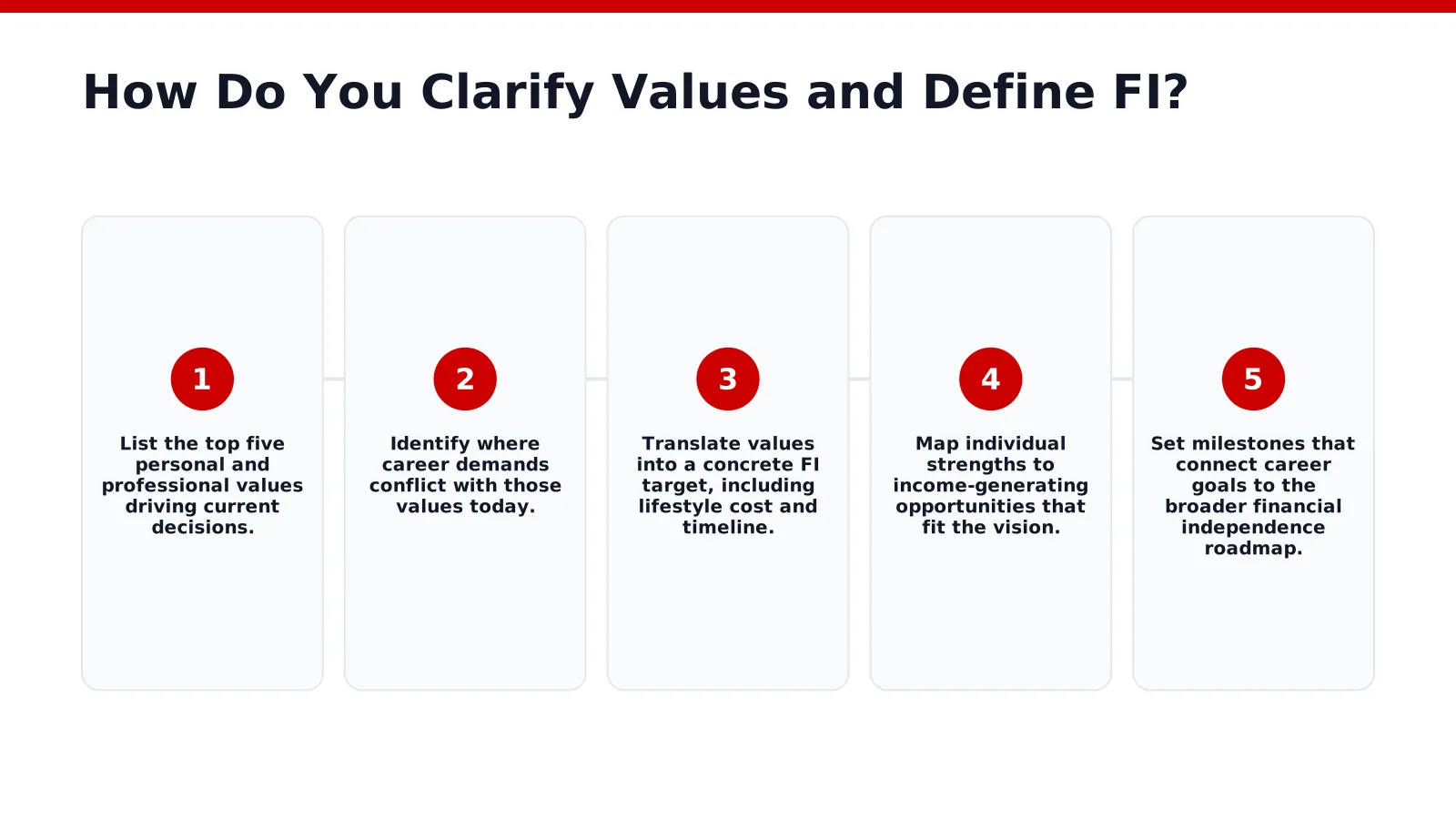
The clarifying process typically follows these steps:
- List the top five personal and professional values driving current decisions.
- Identify where career demands conflict with those values today.
- Translate values into a concrete FI target, including lifestyle cost and timeline.
- Map individual strengths to income-generating opportunities that fit the vision.
- Set milestones that connect career goals to the broader financial independence roadmap.
This approach draws on individual strengths and sets clear financial and career goals for sustainable growth. It moves professionals from uncertainty toward defined next steps, strengthening both career direction and finances at the same time.
How Do You Maximize Career Income Strategically?

Maximizing career income strategically requires pairing targeted positioning with a clear financial endgame. Strategic career growth isn't about working harder. It's about aligning career moves with a broader 10 year wealth plan that turns salary growth into lasting freedom. The job market keeps shifting year after year. The right coaching speeds up both career and financial progress at the same time.
What Role Does Coaching Play in Career Acceleration?
Career coaching built on two decades of hands-on experience helps professionals spot income opportunities they'd otherwise miss. Lee Johnson's background informs the positioning strategies behind faster income growth, from salary negotiation to leadership visibility. That depth of experience matters because retiring on personal terms, without outliving savings, takes more effort and resources today than it did decades ago.
How Does Personalized Coaching Fit Into a Financial Independence Roadmap?
A financial independence roadmap only works when career strategy and personal finance move together, not in separate lanes. VIP Coach keeps that integration tight by accepting just three new clients per month, which keeps the work focused and deeply personalized rather than generic, and executives pursuing fi wealth planning benefit from a structured approach that treats income growth as the engine for everything else. Consider the sequence most high earners follow:
- Audit current compensation against market data and identify the gap between present income and the target needed for freedom.
- Build a personal brand and skill set that justifies promotions, raises, or lateral moves into higher-paying roles.
- Negotiate from a position of strength, using documented wins rather than tenure alone.
- Redirect income gains into passive income vehicles instead of lifestyle inflation.
- Revisit the plan annually with a coach to adjust for market shifts.
Clients who follow this kind of sequencing tend to unlock your potential faster than those chasing promotions without a financial destination in mind. That's the real promise behind Transform with VIP: career momentum and financial freedom, built together, not separately.
How Do You Convert Income Into Assets?

Converting income into assets means redirecting earnings away from one-time spending and into vehicles that keep generating value long after the paycheck lands. Built assets, such as digital products, investment holdings, or ownership stakes, create passive income streams that can cover living expenses on their own. One entrepreneur documented exactly this: passive income from an app, a website, and online courses covered daily life in Argentina while still leaving room for aggressive saving. That's the shift mid-career professionals need: income that works without trading more hours for it.
Smart investing plays a central role in that shift. Treating investment decisions as a defined, ongoing goal, rather than something handled sporadically, helps money grow consistently over time. That consistency builds confidence, and confidence creates room for bolder financial moves later on.
What Tools Help With This Conversion, and Where Does the Strategy Take Shape?
Structured programs give professionals a clearer path from income to assets. Programs like WealthWorks 10X offer tailored tools designed specifically for entrepreneurs managing finances and building wealth effectively, turning scattered financial habits into a repeatable system. Strategy sessions built around asset conversion happen at VIP Coach's Sterling, VA office, where mid-career professionals work through the practical side of turning earnings into holdings. The broader coaching method blends personal growth work with concrete money strategies, so clients feel more in control of every conversion decision rather than guessing at next steps.
Three elements tend to separate steady progress from stalled effort:
- A defined investing goal, reviewed and adjusted regularly
- Passive income sources built deliberately, not left to chance
- Guided financial strategy paired with personal development work
Clients ready to unlock your potential often find that structure, more than willpower, drives the transition from paycheck dependence to asset ownership.
How Do You Diversify Passive Income Streams?

Diversifying passive income means spreading earnings across multiple sources instead of relying on one paycheck or one investment. Retirements now stretch longer than entire careers, with many people living well into their 80s and 90s according to Top 10 Strategies to Achieve Financial Independence. A single income source almost always weakens over time: rankings slip, markets shift, and expenses climb with age. That's exactly why a resilient 10 year wealth plan leans on variety, not a single bet.
What Counts as a Diversified Income Stream?
Diversified income blends active-but-scalable assets with fully passive ones. Real estate sits at the center of this approach for many clients. Lee Johnson, coach, entrepreneur, and real estate investing advocate, brings firsthand property experience into client strategy sessions, pushing clients beyond basic savings accounts toward income-producing assets.
Which Income Streams Should Be On the List?
A sound financial independence roadmap typically includes several categories working together:
- Real estate holdings, from rental property to real estate-backed investments
- Market-based assets, including dividend stocks and diversified funds
- Business or royalty income, built from skills already developed during a career
- Coaching-guided financial planning, which keeps the other streams aligned with long-term goals
No single stream needs to carry the full weight, and clients pursuing fi wealth planning benefit from structured guidance rather than guesswork. The VIP Coach methodology pairs personalized career coaching with practical financial planning, helping clients build multiple income sources without derailing their current job. That combined approach matters: a 5.00 star rating across 14 Google Reviews suggests clients trust this method to guide real diversification decisions, not just theoretical planning. Clients who want to unlock their potential and move past single-source dependency find structure here, step by step, stream by stream.
How Do You Build In Coaching and Accountability?

Accountability starts with a structured coaching relationship, not a one-time pep talk. Mid-career professionals who want lasting results need a system that keeps them on track between sessions. That system begins with a clear commitment from both sides.
Building a financial independence roadmap means more than crunching numbers alone at the kitchen table. Research on financial independence confirms this: GOBankingRates found that financial planners and coaches who specialize in this goal help clients turn the dream into a reality. Professionals who work with a dedicated coach gain structure, feedback, and a second set of eyes on decisions that carry real financial weight. Before booking a session, prospective clients should know what's expected of them, because coaching only works when both parties show up ready to engage.
- Confirm availability. Sessions run Monday through Friday from 10 a.m. to 5 p.m., with Saturday hours from 10 a.m. to 1 p.m.
- Commit to punctuality and preparation. Booking a session means agreeing to arrive on time with goals, questions, and financial documents ready to go.
- Set a recurring cadence. Regular check-ins turn a broad 10 year wealth plan into a series of trackable, achievable milestones.
- Review progress openly. Each session should revisit prior commitments before adding new ones, keeping FI wealth planning honest and grounded in real numbers.
What makes a good financial coach?
Experience and listening skills matter more than credentials alone. One client described finding a mentor like Lee Johnson as a rare discovery, praising his years of experience and his ability to listen closely before mapping out next steps. That kind of attentive guidance is what turns accountability from a buzzword into a daily practice.
What Mistakes Derail a 10-Year Wealth Plan?

Three missteps sink most wealth timelines before year five: ignoring the day job's demands, confusing slowdown with freedom, and skipping the hard trade-off conversations families need to have. Each mistake carries a real cost: stalled progress, blown budgets, and years added back onto the timeline.
Executives building a 10 year wealth plan often treat career and finances as separate tracks. That's the first error. Current job demands, deadlines, travel, long hours, keep pulling focus away from long-term financial goals, and the two sides never get reconciled. The result is a plan that looks good on paper but stalls the moment a demanding quarter hits.
Does financial independence mean working less?
Not exactly. A common misread of financial independence is picturing it as permanent lounging, less effort, fewer hours, slower pace. Real independence comes from building durable income systems that keep running whether someone works 40 hours or 4. Mistaking relaxation for the end goal leads people to under-invest in the systems that actually produce freedom.
Why do family trade-offs wreck the timeline?
Families face genuinely complex financial decisions. Research backs this up: trade-offs between saving, spending, and career risk multiply during the mid-career years. A financial independence roadmap that skips these conversations tends to break under real-world pressure.
Common derailers worth naming directly:
- Treating career and finances as unrelated tracks
- Equating freedom with doing less, not building more
- Avoiding hard trade-off talks with a spouse or partner
- Skipping fi wealth planning reviews once momentum starts
Lee Johnson, drawing on more than 20 years of experience, helps clients spot these patterns early. With the right guidance, professionals learn to unlock their potential and sidestep the mistakes that quietly cost the most time. That guidance is central to how Transform with VIP coaches approach the whole decade-long process.
FAQ
Can you reach financial independence in just 10 years?
Yes. A decade gives mid-career professionals enough runway to escape debt or career stagnation and build real momentum toward financial freedom through diversified investments and passive income, following a solid 10 year wealth plan.
Do you need to quit your job to follow this wealth plan?
No. The VIP Coach methodology builds passive income streams and career coaching alongside full-time work, protecting job security while expanding earning potential through integrated fi wealth planning.
Who guides clients through the 10-year wealth strategy?
Lee Johnson, a Master Certified coach, entrepreneur, and real estate investing advocate based in Sterling, Virginia, personally guides clients through their 10-year wealth strategies at VIP Coach.
Conclusion
In closing, your 10 year wealth plan isn't about perfection, it's about momentum built on multiple income streams, honest accountability, and the willingness to align your career with your financial goals. The professionals who reach financial independence do so because they commit to the process, show up consistently, and let structured guidance keep them honest when life gets messy. You've got a decade ahead of you. The question isn't whether it's possible, it's whether you're ready to build the systems that make it real.
Contact VIP Coach
- 📞 Phone: (571) 605-1484
- ✉️ Email: [email protected]
- 📅 Consultation: Book a Free Clarity Call with Coach Lee
- 🌐 Website: transformwithvip.com
- Service Area: Sterling, VA and surrounding areas